By Sarah Whitfield, Skincare Editor | Reviewed for accuracy
Vitamin C serum is one of the few skincare ingredients with real clinical evidence behind it. Used consistently, it can:
For more on this, see our guides to how to build the perfect skincare routine for your skin type, the correct order for your skincare routine and AHA vs BHA vs PHA exfoliants explained.
Neutralise free radicals from UV light and pollution, backing up your sunscreen
Support collagen production, which softens fine lines over time
Fade dark spots – one study cited by Cleveland Clinic found 73% of users saw improvement in hyperpigmentation
Even out tone and add brightness by reducing melanin overproduction
Most people should apply it in the morning, look for a 10–20% L-ascorbic acid formula (or a gentler derivative if their skin is reactive), and give it about three months before judging results. It’s not a substitute for sunscreen – it works alongside it.
Below, we break down how it actually works, who should be cautious, and which ingredients to pair it with (and which to avoid).
What Does Vitamin C Actually Do for Your Skin?
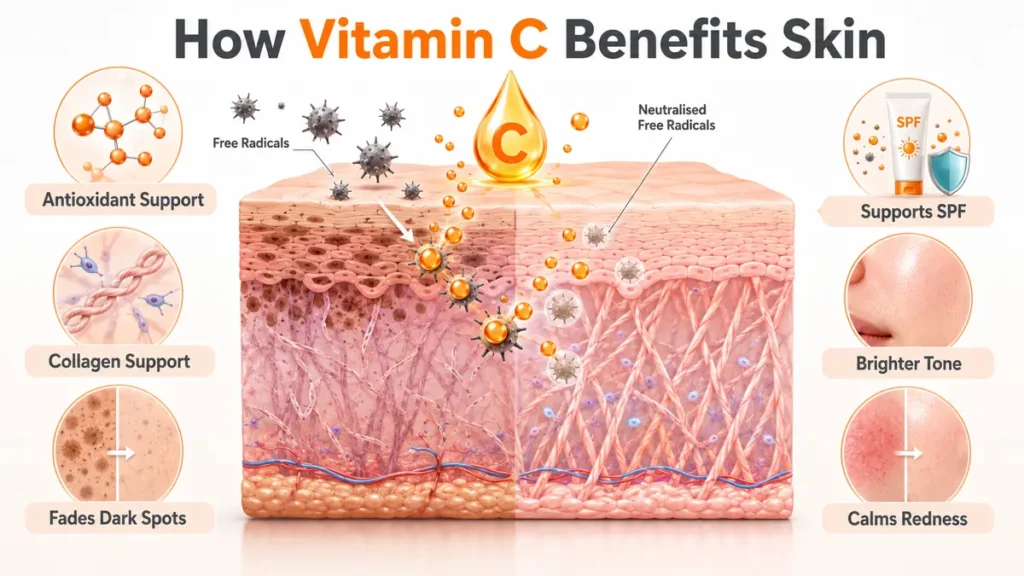
Vitamin C (also labelled ascorbic acid or L-ascorbic acid) is an antioxidant. That’s the whole job, mechanically: it donates electrons to unstable molecules called free radicals before those molecules can damage your skin cells.
Free radicals build up from everyday exposure – sunlight, air pollution, cigarette smoke, even normal metabolism. Left unchecked, this oxidative stress speeds up visible ageing and breaks down collagen.
Dermatologist Melissa Piliang, MD, at Cleveland Clinic, puts it plainly: “There’s good scientific evidence to show that vitamin C has antioxidant effects. Using topical vitamin C can result in less cell damage and better-looking skin.”
According to the American Academy of Dermatology (AAD), vitamin C also plays a role in collagen formation, which is why it’s frequently recommended alongside sunscreen as part of an anti-ageing routine – not as a replacement for it.
What Are the Main Benefits of Vitamin C Serum?
1. It backs up your sunscreen
Vitamin C doesn’t block UV rays the way SPF does, but it mops up free radicals that slip through. Cleveland Clinic notes that combining vitamin C with sunscreen gives measurably better protection against sun-induced skin damage than sunscreen alone.
2. It supports collagen and softens fine lines
As skin ages, natural collagen production slows. Topical vitamin C has been shown to help protect existing collagen and encourage new synthesis, which is why consistent users often report firmer-looking skin after a few months.
3. It fades hyperpigmentation
Vitamin C interferes with excess melanin production. A study referenced by Cleveland Clinic found 73% of participants saw improved hyperpigmentation with topical use – though the researchers noted the effect isn’t permanent and fades once you stop applying it.
4. It can soften dark under-eye circles
A small 14-person study found vitamin C improved the appearance of dark circles caused by pooled blood under the eyes, likely by thickening the skin in that area over time.
5. It may help with acne-related redness
Some research points to mild anti-inflammatory effects that can calm redness associated with breakouts, though vitamin C isn’t classified as an acne treatment on its own.
6. It brightens overall tone
By limiting oxidative damage and pigment build-up, skin generally looks more even and less dull with regular use.
What’s the Best Vitamin C Concentration?
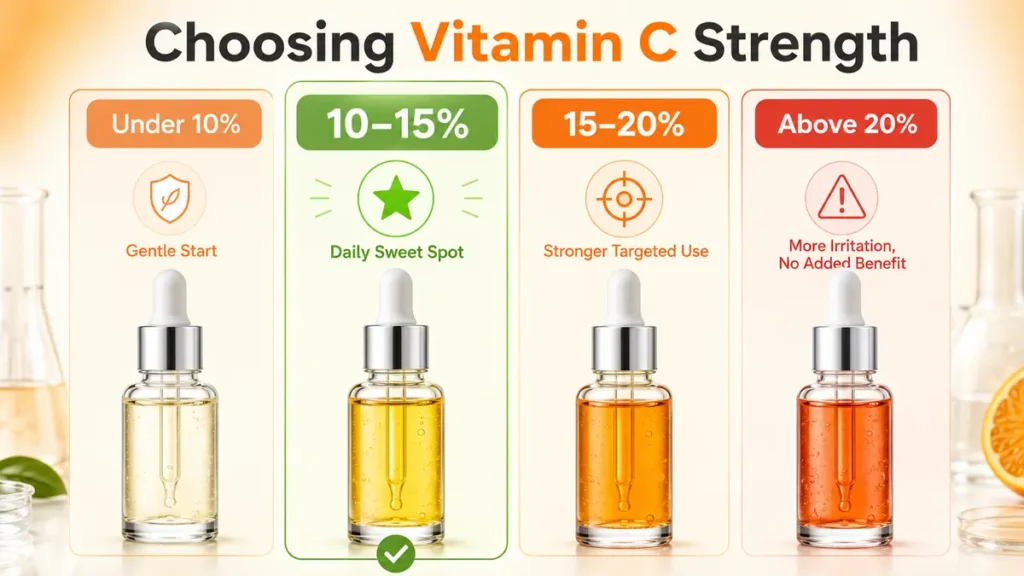
This is where a lot of buying guides get vague. Here’s what the formulation research actually shows:
Concentration | What to expect | Best for |
|---|---|---|
Under 10% L-ascorbic acid | Mild antioxidant effect, gentle | Beginners, sensitive skin, first-time users |
10–15% | Widely considered the effective “sweet spot”; good penetration with manageable irritation | Most skin types, daily use |
15–20% | Strongest documented benefit for hyperpigmentation and firmness | Resilient, non-sensitive skin targeting sun damage |
Above 20% | No added clinical benefit; irritation risk rises sharply | Not generally recommended |
Cleveland Clinic’s guidance lines up with this: look for 10–20% concentration – anything lower “won’t convey the benefits you’re looking for,” while anything higher “risks seriously irritating your skin.”
Formulation matters too. Pure L-ascorbic acid needs a low pH (around 2.5–3.5) to stay active, which is also why it can sting on reactive skin. Derivatives like magnesium ascorbyl phosphate or ascorbyl glucoside work at a gentler, near-neutral pH – less potent, but far less likely to irritate.
Who Should Avoid Vitamin C Serum, or Use It Carefully?

Most people tolerate vitamin C well. But a few groups should be more cautious:
Rosacea-prone skin: low-pH L-ascorbic acid formulas can trigger stinging, flushing, or flare-ups. A gentler derivative is usually the better starting point.
Very sensitive or barrier-compromised skin: start with a low concentration (under 10%) and patch-test on the inner arm for 48 hours first.
Anyone new to actives: introduce it 2–3 times a week before going daily, so you can see how your skin responds.
People combining multiple strong actives already: adding vitamin C on top of retinoids, strong acids, and benzoyl peroxide in the same routine raises irritation risk – space them out (see the table below).
If you notice persistent burning, redness that doesn’t fade, or breakouts after starting a vitamin C serum, stop use and check in with a dermatologist rather than pushing through it.
Morning or Evening: When Should You Apply It?
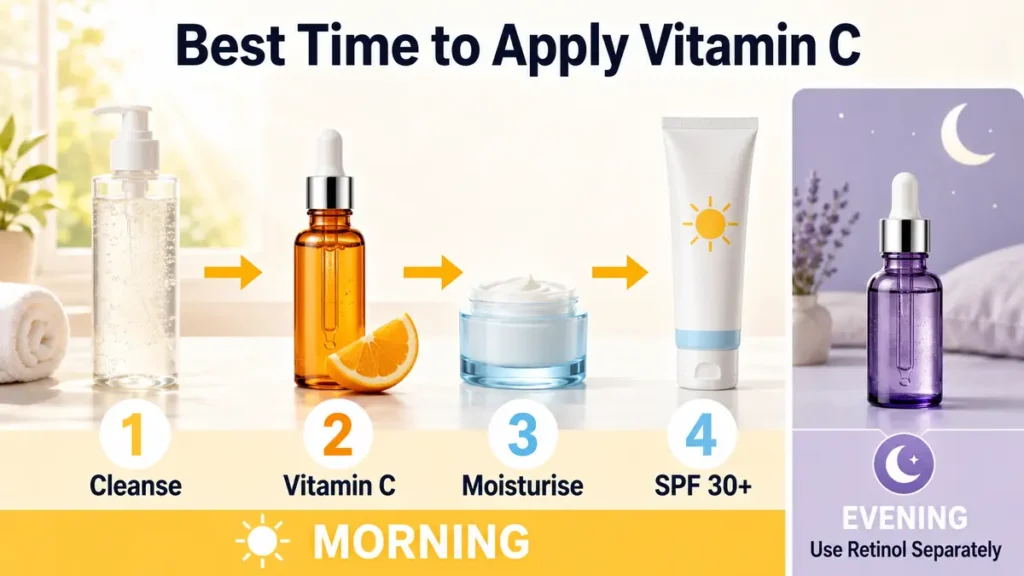
Morning is the standard recommendation, and for a specific reason: vitamin C’s antioxidant action is most useful when it’s actively fighting the free radicals generated by daytime UV exposure and pollution. Dr. Piliang recommends applying it in the morning specifically because “they work in synergy” with sunscreen.
Morning routine: Cleanse → vitamin C serum → moisturiser → SPF
Evening use isn’t harmful if your skin tolerates it, but there’s less functional reason for it, and layering it with retinol at night raises the odds of irritation.
Best practice split: vitamin C in the morning, retinol (or other exfoliating actives) at night – so the two potent ingredients aren’t competing for the same window.
Give it time. Dr. Piliang’s clinical advice: expect about three months of consistent use before you can properly judge results – and photograph your skin monthly so you’re not relying on memory.
Ingredient Pairing: What to Combine With Vitamin C (and What to Avoid)
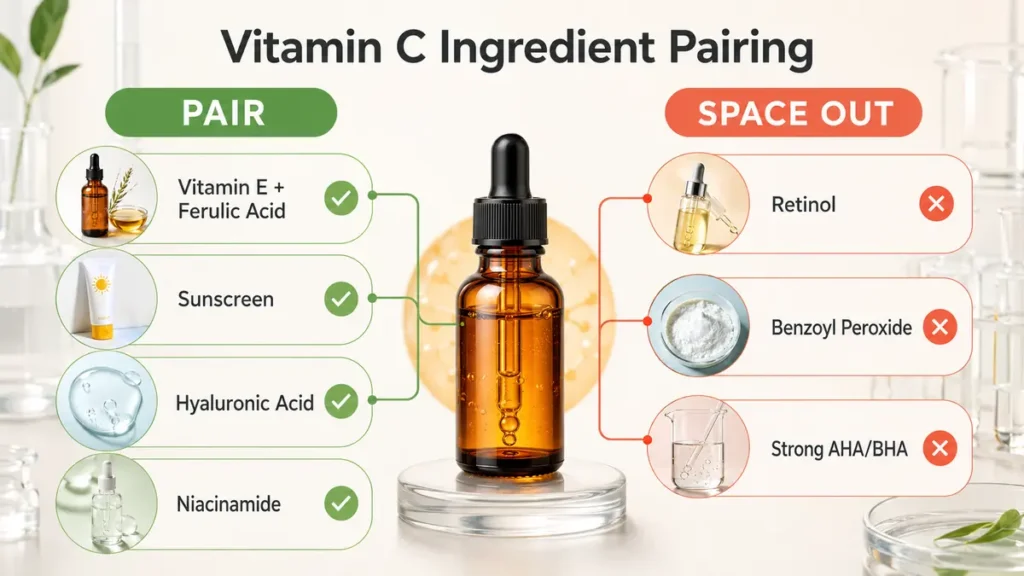
This is the part most articles skip over or oversimplify. Here’s a dos-and-don’ts breakdown based on how these ingredients chemically interact:
Pair with Vitamin C | Verdict | Why |
|---|---|---|
Vitamin E + ferulic acid | ✅ Do | Classic combination (as in the well-studied CE Ferulic formula); stabilises vitamin C and boosts antioxidant protection against sun damage |
Sunscreen (SPF) | ✅ Do | Vitamin C is a complement to SPF, not a replacement – apply serum first, sunscreen last |
Hyaluronic acid | ✅ Do | No conflict; HA hydrates while vitamin C works on antioxidant/brightening effects |
Niacinamide | ✅ Generally fine | Older claims that they cancel each other out came from outdated, extreme-heat lab conditions; modern stable formulas layer safely for most skin |
Retinol / retinoids | ⚠️ Caution | Conflicting pH needs (vitamin C is acidic, retinol works better at higher pH) can reduce efficacy and stack irritation – separate by time of day (AM/PM) rather than combining |
Benzoyl peroxide | ❌ Avoid combining directly | Benzoyl peroxide is an oxidiser and can neutralise vitamin C’s antioxidant activity – use vitamin C in the morning, benzoyl peroxide separately |
Strong exfoliating acids (AHA/BHA) at high % | ⚠️ Caution | Multiple acidic, low-pH products in one routine raise irritation risk – introduce gradually, not all at once |
Bottom line on pairing: vitamin C plays well with antioxidants, hydrators, and sunscreen. It needs more careful scheduling around retinoids, benzoyl peroxide, and other strong acids – not because it’s “dangerous,” but because stacking actives without spacing them out is the most common cause of irritation dermatologists see.
How to Add Vitamin C Serum to Your Routine

Patch test first, especially with concentrations above 10%.
Apply after cleansing, before moisturiser, on clean, dry skin.
Use a few drops – a little goes a long way; more product doesn’t mean faster results.
Follow with SPF 30+ every morning, rain or shine.
Store it right: vitamin C degrades with light, heat, and air exposure. A serum that’s turned dark yellow or brown has likely oxidised and lost potency – opaque or dark glass bottles help it last.
Be patient: three months of consistent use is the realistic timeline for visible change, per dermatologist guidance.
For more on how sunscreen fits around your antioxidant routine, see our guide to the correct order for your skincare routine. If you are building a full routine, read our guide to the perfect skincare routine for your skin type.
Frequently Asked Questions
Do vitamin C serums really work, or is it hype?
There’s genuine clinical evidence behind it – the AAD and Cleveland Clinic both cite studies showing improved hyperpigmentation, collagen support, and antioxidant protection. It’s one of the more evidence-backed ingredients in skincare, though results build gradually over months, not days.
What percentage of vitamin C serum is best for beginners?
Start under 10% L-ascorbic acid, or try a gentler derivative like magnesium ascorbyl phosphate. Once your skin tolerates it, 10–15% is considered the effective range for most people.
Can I use vitamin C serum every day?
Yes, daily use is generally considered safe for most skin types, especially at 10–15% concentrations. Those with sensitive skin may prefer starting a few times a week.
Can I use vitamin C and retinol together?
You can use both in the same routine, but layering them back-to-back can increase irritation and reduce efficacy due to conflicting pH requirements. Most dermatologists suggest vitamin C in the morning and retinol at night.
Why did my vitamin C serum turn orange or brown?
That’s oxidation – exposure to light, heat, or air breaks down the active ingredient. An oxidised serum won’t cause harm, but it’s largely lost its effectiveness, so it’s time to replace it.
Is vitamin C serum safe during pregnancy?
The AAD notes topical vitamin C is commonly used to help manage pregnancy-related skin tone changes and is generally considered a suitable option, though it’s always worth checking any new active ingredient with your own doctor first.
Related Reading
- How to Build the Perfect Skincare Routine for Your Skin Type (2026 Complete Guide)
- Skincare Steps: The Correct Morning and Night Order
- The Science Behind Glass Skin: Your Complete Guide — What Korean Dermatologists Actually Know (And The West Ignores)
- Peptides for Skin: What They Do, What the Evidence Says and How to Use Them
Browse more in Skin Care or return to the GlowCulture homepage.
Useful Sources
Harvard Health Publishing – Why Is Topical Vitamin C Important for Skin Health?
PubMed – Topical vitamin C and the skin (hyperpigmentation study)
This article is for informational purposes and doesn’t replace personalised advice from a board-certified dermatologist.