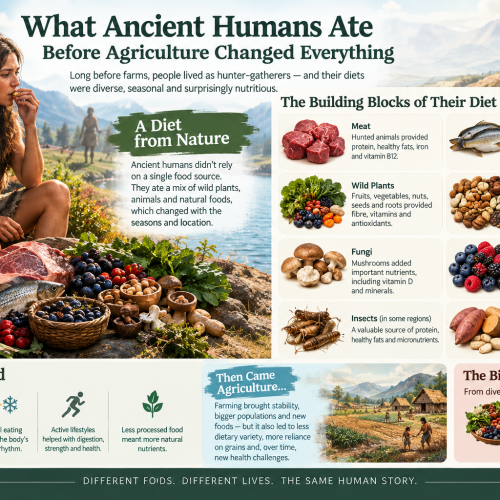





The “Paleo diet” image most people carry around — a caveman gnawing on a mammoth leg — is almost the opposite of what the archaeological evidence actually shows. Some of the most recent research, published as recently as late 2025, paints a very different picture: humans and their hominin ancestors were processing, grinding, and cooking plant foods for hundreds of thousands of years before agriculture existed, and in some populations, plants — not meat — were the dominant source of what ancient humans ate before agriculture dietary protein.
The “Big-Game Hunter” Theory Is Being Overturned

For decades, the dominant model in anthropology, known as the Broad Spectrum Revolution theory, held that early humans were primarily big-game hunters and only began seriously incorporating small game, fish, and plants late in prehistory, right before agriculture emerged. A 2025 review from researchers at the Australian National University and the University of Toronto Mississauga challenges this directly. After reviewing archaeological evidence from sites worldwide, the researchers concluded that humans evolved as “broad-spectrum” eaters from far earlier than previously believed — grinding wild seeds, cooking starchy roots, and processing nuts tens of thousands of years before that supposed late-stage dietary shift. Starch grains recovered from the dental calculus of an early hominin site in Spain have even been dated to roughly 1.2 million years what ancient humans ate before agriculture ago.
Direct Evidence: What Was Actually on the Menu
This isn’t guesswork based on modern hunter-gatherer analogies — it’s built on physical evidence. At Ohalo II in Israel and other sites, researchers have found grinding tools with starch residues from wild seeds and grasses. At a site in Jordan, and later at caves in Israel and Iraq (Franchthi and Shanidar), archaeologists identified carbonized food remains — essentially prehistoric bread, patties, and porridge — made from pulses and wild grass seeds, some dating back nearly 14,400 years, well before farming began in that region. In South Africa, evidence of crushed wild grass seeds has been dated to around 100,000 years ago.
Perhaps the most striking recent finding comes from Taforalt Cave in Morocco, where researchers analyzed isotopic signatures in the bones and teeth of hunter-gatherers who lived there between 13,000 and 15,000 years ago. The results showed that plants, not meat, were their primary source of dietary protein — a finding that directly contradicts the long-standing assumption that pre-agricultural humans were predominantly meat-eaters. The same population also showed unusually high rates of tooth decay, consistent with a diet rich in fermentable starchy plants such as wild cereals or what ancient humans ate before agriculture acorns.
A Global, Not Regional, Pattern
This wasn’t a one-off local adaptation. Similar plant-heavy diets just before the agricultural transition have been documented in the Levant region of the Middle East. In southern China, starch and plant-residue analysis at ancient sites shows that sago-type palms, wild bananas, roots, tubers, and wild rice were staple plant foods well before rice farming took hold — and researchers believe the shift to labor-intensive rice agriculture was a slow, reluctant transition precisely because these existing plant foods were already meeting people’s nutritional what ancient humans ate before agriculture needs.
Why This Matters for How We Think About “Ancestral” Eating
Much of the popular Paleo-diet narrative is built on the assumption that our ancestors ate an overwhelmingly animal-based diet, and that modern grain- and plant-heavy diets are the historical anomaly. The archaeological record complicates that story considerably. Plant processing — grinding, cooking, fermenting — appears to be an ancient, foundational human skill, not a late add-on. As one of the 2025 study’s co-authors put it, early humans evolved as “plant-loving, tool-using foodies who could turn almost anything into dinner,” and today, roughly 80% of the global diet by composition is still plant-based — arguably a direct legacy of that deep adaptability, even as modern agriculture has narrowed the range of crops involved.
None of this means meat wasn’t important — hunting clearly mattered, and diets varied enormously by region, climate, and available resources. The real finding is variety and adaptability: humans succeeded as a species by being able to extract nutrition from an unusually wide range of food sources, not by specializing narrowly in one macronutrient what ancient humans ate before agriculture category.
Frequently Asked Questions
Did early humans mostly eat meat before agriculture?
No. Isotopic and archaeological evidence increasingly shows that plant foods, in some populations, made up the majority of dietary protein even in pre-agricultural hunter-gatherer groups.
How do scientists know what ancient humans ate?
Through multiple lines of evidence: carbonized plant remains found in ancient hearths, starch residues on grinding and pounding tools, dental calculus analysis, and isotopic signatures preserved in bones and teeth.
When did humans start processing plant foods?
Evidence of starch processing dates back at least 100,000 years in South Africa, and starch grains on hominin teeth from Spain have been dated to roughly 1.2 million years ago — far earlier than agriculture, which began around 10,000–12,000 years ago.
What is the “Broad Spectrum Revolution” theory?
A long-standing anthropological model proposing that hunter-gatherers only began seriously using plants, small game, and fish late in prehistory. Recent evidence suggests this dietary breadth existed hundreds of thousands of years earlier than the what ancient humans ate before agriculture theory proposed.
Is the modern “Paleo diet” accurate to what ancient humans actually ate?
Not entirely. The archaeological record shows a much larger role for processed plant foods — ground seeds, cooked tubers, wild grains — than the meat-heavy image typically associated with the Paleo diet.
Why did some populations delay adopting agriculture even when farming was available nearby?
In some regions, existing wild plant foods already provided a diet similar in plant content to farmed diets, reducing the immediate pressure to adopt labor-intensive what ancient humans ate before agriculture agriculture.
Conclusion
The story of what humans ate before agriculture isn’t a simple tale of meat-eating hunters who eventually settled down to farm grain. It’s a story of remarkable dietary flexibility — humans processing, cooking, and relying on plants for hundreds of thousands of years, adapting their diets to dozens of different environments long before the first crop was ever planted. Understanding that history is a useful corrective to any modern diet trend that claims to simply be “returning” to how we ate before what ancient humans ate before agriculture civilization.
Sources & Further Reading
Primary sources: CNN coverage of the Taforalt isotope study and the original Taforalt research on NCBI.
Related reading: why ancient humans needed different nutrition than modern humans and forgotten foods that protected ancient humans from deficiency.