




If you ask most people when nutrition science really became advanced, they might point to the last two decades—the age of macro tracking, continuous glucose monitors, personalized diets, and gut microbiome testing. Very few would choose 1945.
Yet the years immediately following World War II were an important period in postwar nutrition science. Some scientists believed that nutrition had already solved its biggest mysteries because many major vitamins and their related deficiency diseases had been identified.
For more on this, see our guides to the forgotten scientists who built modern nutrition, anti-inflammatory foods to add to your diet and the complete anti-inflammatory diet food list.
That assumption was understandable—but wrong.
The story of postwar nutrition science reveals something fascinating about how scientific knowledge develops. Important discoveries do not always become popular knowledge immediately. Some findings remain buried in specialist journals, while others are overshadowed by political priorities, funding changes, or newer research postwar nutrition science trends.
Why Scientists Thought Nutrition Science Was Finished

Between 1912 and 1944, nutrition research moved at an extraordinary pace. Scientists identified vitamins associated with diseases such as rickets, scurvy, beriberi, pellagra, and xerophthalmia.
By the end of World War II, many of the major vitamins had been identified, named, and connected with particular deficiency diseases. It was therefore easy to imagine that the most important work had already been completed.
Oxford University provides a striking example. Shortly after the war, its nutrition research group was closed because university leadership believed that the subject had largely been “worked out.”
But identifying vitamins was only the beginning.
Researchers still had major questions to answer. They needed to understand how nutrients functioned inside the body, how different nutrients interacted, how protein quality affected health, and what happened when entire populations experienced several nutrient deficiencies at the same postwar nutrition science time.
These unanswered questions became central to postwar nutrition science.
What Was Discovered Between 1945 and 1960?
While some institutions were reducing their focus on nutrition, researchers elsewhere were making important discoveries.
One area of investigation involved liver damage associated with poor-quality protein diets. Researchers found that adding the amino acid methionine to the diets of laboratory rats could prevent a form of liver necrosis. This helped demonstrate that protein quality could matter—not simply the total amount of protein consumed.
German biochemist Klaus Schwarz was also investigating this type of liver damage during the difficult final years of World War II. His research eventually connected wheat germ and vitamin E with protection against the condition.
The work was remarkable given the circumstances. Scientific research was continuing even while wartime conditions made laboratories, supplies, and communication extremely postwar nutrition science difficult.
The Continuing Mystery of Folic Acid
Folic acid was another unfinished chapter.
By the mid-1940s, researchers already knew that folic acid was an important vitamin and that it was connected with certain forms of anemia. However, scientists were still discovering its broader significance in humans.
Its importance during pregnancy would become much clearer in the decades that followed. Eventually, research into folic acid contributed to public-health policies designed to reduce the risk of neural tube defects.
This is one reason postwar nutrition science matters today: researchers were not simply identifying nutrients. They were gradually discovering what those nutrients actually meant for human postwar nutrition science health.
The Discovery of Multiple Micronutrient Deficiency
Perhaps the biggest conceptual change came from looking beyond individual vitamins.
After the war, international organizations began conducting nutrition surveys in populations affected by poverty, food shortages, and poor access to diverse foods. The Food and Agriculture Organization was established in 1945, UNICEF in 1946, and the World Health Organization in 1948.
In 1949, a joint FAO/WHO expert committee identified kwashiorkor as one of the major nutrition disorders affecting tropical and subtropical regions.
Pediatrician Cicely Williams had already described the condition in West Africa years earlier. Her observations helped establish that childhood malnutrition could involve much more than one missing postwar nutrition science vitamin.
This became a major lesson of postwar nutrition science.
Real-world malnutrition rarely fits neatly into a single deficiency category. A person or population may simultaneously experience inadequate protein, iron, iodine, vitamin A, and other essential postwar nutrition science nutrients.
The focus therefore began shifting from:
“Which vitamin is missing?”
to:
“Which combination of nutrients is missing, and why?”
That was a major change in how researchers understood malnutrition.
The Forgotten Pioneers of Nutrition Research
Several researchers contributed important work during this broader period, but their names are not nearly as familiar to the public as today’s nutrition influencers and health postwar nutrition science personalities.
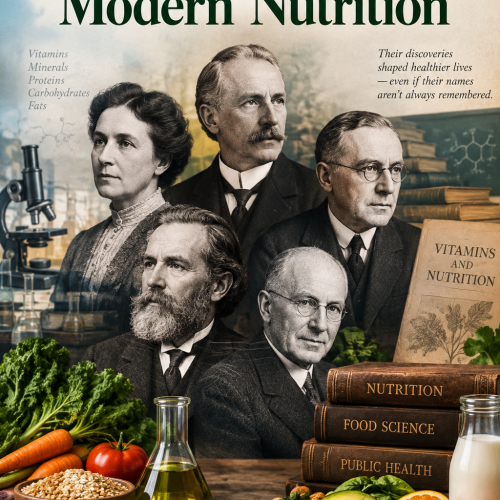
Robert McCarrison
British physician Robert McCarrison conducted extensive nutrition research in India during the early 20th century. His experiments examined relationships between diet and disease and helped establish an early interest in population-level nutrition.
His work also emphasized the potential importance of food quality and minimally processed diets long before the modern discussion about ultra-processed postwar nutrition science foods.
Harriette Chick
Harriette Chick conducted important research into rickets among malnourished children in Vienna. Her work demonstrated the benefits of cod liver oil and ultraviolet light exposure and contributed to the growing understanding of vitamin D.
Her research helped establish methods that later nutrition researchers could apply to populations affected by war and food shortages.
Klaus Schwarz
Klaus Schwarz’s research connected vitamin E with protection against a measurable form of liver damage in animal studies. His work was conducted under extremely challenging wartime conditions.
Cicely Williams
Cicely Williams transformed clinical observations of childhood malnutrition into the recognition of kwashiorkor as a major nutrition disorder.
Together, these researchers represent an important but often overlooked chapter of postwar nutrition science.
From Preventing Deficiency to Questioning the Affluent Diet
Before World War II, much of nutrition research focused on deficiency.
The basic question was:
What nutrient is missing, and how can we replace it?
As food supplies improved in wealthier countries after the war, researchers began asking a different question.
What happens when people have plenty of food—but the overall diet is poor in quality, overly abundant, or lacking nutritional balance?
This shift eventually contributed to research into diet quality, chronic disease, and the health effects of highly processed foods.
In that sense, postwar nutrition science helped move the field beyond simply preventing dramatic deficiency diseases.
Nutrition researchers increasingly had to consider both sides of the problem:
Too little nutrition—and too much of the wrong kind of food.
Why Did These Discoveries Fade From Public View?
The research was not necessarily hidden or deliberately suppressed.
Instead, it became less visible for ordinary reasons.
First, much of the work appeared in specialist scientific journals rather than publications read by the general public.
Second, postwar governments and organizations were dealing with immediate problems such as rationing, agricultural reconstruction, food availability, and displaced populations.
Third, some researchers worked in complicated political and institutional environments that made their findings less likely to circulate widely.
Finally, nutrition research later moved toward other high-profile questions involving cholesterol, sugar, fat, and macronutrient ratios.
As a result, important findings from postwar nutrition science became less familiar outside academic and medical circles.
The knowledge did not necessarily disappear.
It simply stopped being part of the popular conversation.
What Modern Nutrition Research Is Re-Examining
Some themes from this earlier period now sound surprisingly modern.
Researchers today continue to investigate multiple micronutrient deficiencies and the concept of “hidden hunger”—where someone may consume enough calories while still failing to obtain adequate amounts of essential nutrients.
The relationship between food processing and health has also become a major area of modern nutrition research.
And folic acid research from the 1940s eventually contributed to modern food-fortification policies designed to help prevent neural tube defects during pregnancy.
These developments show how postwar nutrition science sometimes anticipated questions that would become mainstream decades later.
Modern research is not simply copying old conclusions. Instead, it is testing, refining, expanding, and sometimes challenging earlier ideas with better methods and larger datasets.
What Can We Learn From This History?
The most useful lesson may be that nutritional problems rarely exist in isolation.
If someone’s diet is low in iron, for example, other nutritional factors may also deserve attention. Vitamin C can influence iron absorption, while other nutrients such as vitamin B12 have their own important roles.
The broader point is not to start taking supplements blindly.
It is to avoid thinking about nutrition as a collection of isolated numbers.
Postwar nutrition science showed that the human diet is interconnected. Nutrients interact with each other, food quality matters, and population-level health cannot always be explained by one deficiency at a time.
It also provides a useful warning against declaring nutrition science either completely “settled” or entirely new.
Science is often a process of discovery, forgotten evidence, reinterpretation, and refinement.
Myths vs. Scientific Reality
Myth: Nutrition science only became important during the low-fat or keto era.
Reality: Many foundational vitamin and deficiency discoveries had already been made by the 1940s. Later research expanded and applied those discoveries.
Myth: A deficiency only matters if it causes an obvious disease.
Reality: Nutritional shortages can overlap and may not always produce one dramatic, recognizable symptom.
Myth: Old nutrition research is automatically obsolete.
Reality: Foundational findings can continue to influence modern research. Later scientists can test, refine, and build upon earlier discoveries.
Frequently Asked Questions
Why did Oxford close its nutrition research group after WWII?
The available historical account indicates that university leadership believed many major nutrition discoveries had already been made, particularly the identification of important vitamins and their associated deficiency diseases.
What is kwashiorkor?
Kwashiorkor is a severe form of protein malnutrition that typically affects young children. Cicely Williams helped establish it as a recognized nutritional disorder through her clinical work in West Africa.
Who was Robert McCarrison?
Robert McCarrison was a British physician who conducted extensive nutrition research in India and investigated relationships between diet and disease. His work became associated with population-level nutrition research.
What did Klaus Schwarz discover?
Schwarz’s research found that vitamin E could prevent a particular form of liver necrosis in animal studies associated with poor-quality protein diets.
When was folic acid identified?
Research establishing folic acid as an important vitamin dates to the first half of the 20th century, with significant developments continuing through the 1940s and later decades.
Which organizations became important in postwar nutrition?
The Food and Agriculture Organization was established in 1945, UNICEF in 1946, and the World Health Organization in 1948. These organizations became involved in international nutrition research and intervention.
Was multiple micronutrient deficiency a new idea?
The recognition that populations could experience several nutrient deficiencies simultaneously developed through nutrition surveys and research during the postwar period.
Why does this history matter today?
It demonstrates that many ideas appearing in modern nutrition discussions have much older roots. Postwar nutrition science helped establish concepts involving nutrient interactions, population-level malnutrition, diet quality, and the long-term importance of micronutrients.
Conclusion
Nutrition science did not simply stop after World War II.
Instead, an important part of its progress moved quietly through specialist laboratories, hospitals, universities, and international nutrition surveys.
The postwar years produced important work involving vitamin E, folic acid, protein quality, kwashiorkor, and multiple micronutrient deficiency. Researchers such as Robert McCarrison, Harriette Chick, Klaus Schwarz, and Cicely Williams contributed to a body of knowledge that continues to influence nutrition research.
The real lesson of postwar nutrition science is not that scientists of the past knew everything.
It is almost the opposite.
They had answered some major questions—but discovering vitamins was only the beginning. Understanding how nutrients interact, how diets affect entire populations, and how nutritional quality influences long-term health required decades more research.
That is why some of the most interesting nutrition discoveries are not necessarily the newest ones.
Some are the discoveries we almost forgot.