
Skin Care7 min read
Skin Cycling Routine for Beginners UK: A Simple 4-Night Plan
 Aiman Shahzadi··Updated 20 Nov 2026·No Comments
On this page
- What is skin cycling?
- Who is skin cycling good for?
- Who should be careful or speak to a professional first?
- What you need to start
- The 4-night skin cycling routine
- The retinol sandwich method
- What about mornings?
- Adjusting skin cycling for the UK
- A 4-week starter plan
- Common skin cycling mistakes
- When to stop and get advice
- Frequently asked questions
- The bottom line
By [Aiman Shazadi]

A skin cycling routine is a simple four-night evening plan that helps beginners use strong skincare ingredients without irritating their skin. In this guide, you will learn exactly what to do each night, how to adjust it for UK weather, and which mistakes to avoid.
Quick answer: Skin cycling is a four-night evening routine. Night 1 is a gentle exfoliation, Night 2 is a retinoid, and Nights 3 and 4 are recovery nights with only hydrating and barrier-friendly products. Then you repeat. It helps beginners use strong ingredients without overdoing them.
If you have ever stood in front of your bathroom shelf wondering which serum to use tonight, skin cycling is designed for you. It gives every night a job, so you do not use everything at once and irritate your skin.
This guide explains what skin cycling is, who it suits, exactly what to do each night, and how to adjust it for British weather.
What is skin cycling?
Skin cycling is a rotating evening routine popularised by US dermatologist Dr Whitney Bowe. Instead of layering active ingredients every night, you alternate between “active” nights and “rest” nights.
The idea is simple: active ingredients such as exfoliating acids and retinoids can work well, but using them too often can leave skin dry, tight and sore. Rest nights give the skin barrier time to recover.
Who is skin cycling good for?
Skin cycling is a good starting point if you:
- are new to retinol or exfoliating acids
- have sensitive or easily irritated skin
- tend to use too many products at once
- like a clear routine you can follow without guessing
Who should be careful or speak to a professional first?
Check with a GP, pharmacist or dermatologist before starting if you:
- are pregnant, trying to conceive or breastfeeding (retinoids are usually avoided in pregnancy)
- have eczema, rosacea or active, broken or very inflamed skin
- are using prescription treatments for acne or other skin skin cycling routine conditions
This article is general information, not medical advice.
What you need to start
Keep it simple. You need only four things for the evening, plus sunscreen for the morning:
- A gentle cleanser that does not leave your face squeaky or tight.
- A chemical exfoliant (for example a lactic acid, mandelic acid or low-strength glycolic acid product). Beginners should avoid harsh scrubs.
- A retinoid (such as retinol). Start with a low strength.
- A moisturiser with barrier-friendly ingredients such as ceramides, glycerin or hyaluronic acid.
- SPF 30 or higher every morning. Exfoliants and retinoids can make skin more sensitive to the sun, and UK daylight still counts.
Many pharmacy and high-street brands sold at Boots and Superdrug make these basics. You do not need an expensive set to skin cycling routine begin.
The 4-night skin cycling routine
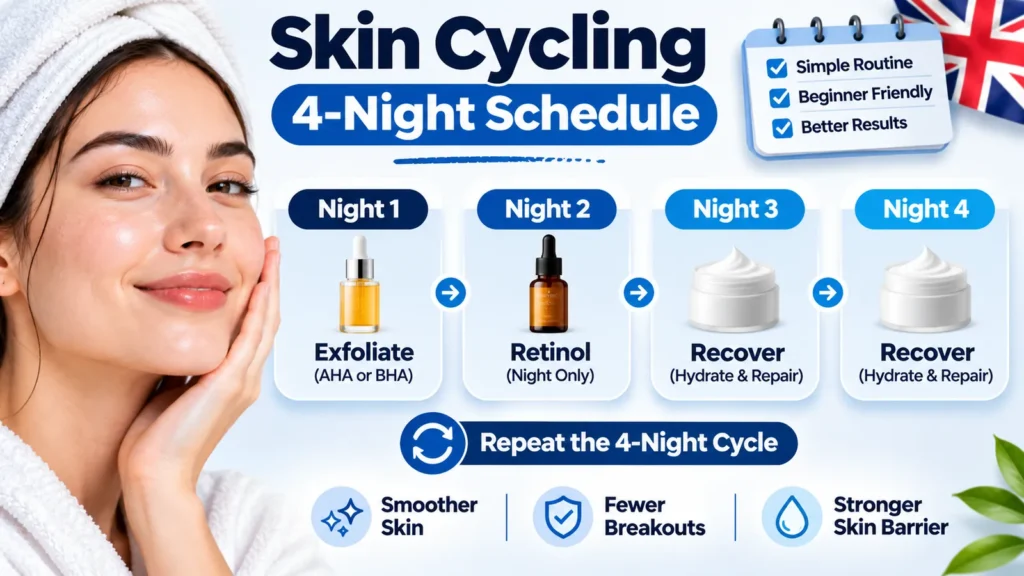
Night 1: Exfoliate
- Cleanse your face and pat it dry.
- Apply your chemical exfoliant as directed on the label.
- Follow with a simple moisturiser.
Avoid scrubbing. The goal is to gently clear away dull surface skin so your skin feels smoother.
Night 2: Retinoid
- Cleanse and dry your face fully.
- Apply a pea-sized amount of retinol to the whole face, avoiding the eyes and corners of the nose and mouth.
- Follow with moisturiser.
If your skin is sensitive, try the sandwich method skin cycling routine below.
Night 3: Recovery
Cleanse, then use a hydrating serum (if you like) and a nourishing moisturiser. No acids, no retinol, no scrubs.
Night 4: Recovery
Repeat Night 3. Your skin barrier is rebuilding, so keep it calm and comfortable.
On Night 5, you start again with skin cycling routine exfoliation.
The retinol sandwich method

If retinol makes your skin feel dry or stingy, use the sandwich method on Night 2:
- Apply a thin layer of moisturiser.
- Apply your retinol.
- Finish with another layer of moisturiser.
The moisturiser layers act as a buffer, so the retinol feels gentler. Results may be slower, but many beginners find it easier to stick with.
What about mornings?
Skin cycling only changes your evening routine. In the morning, keep it the same every day:
- Gentle cleanse (or just rinse with water if your skin is dry).
- A light moisturiser.
- Sunscreen, every day.
Adjusting skin cycling for the UK
British weather can change how your skin behaves, so adjust the routine to match.

- Cold air and central heating dry out skin quickly. In winter, use a richer moisturiser on recovery nights and consider a humidifier in the bedroom.
- Hard water in many parts of the UK can leave skin feeling tight after washing. Use a gentle, non-foaming cleanser and avoid very hot water on your face.
- Winter sun is weaker but not absent. Keep wearing SPF, especially if you spend time outdoors or near snow-reflecting light.
- Skin feels worse in cold snaps? Add an extra recovery night rather than pushing through.
A 4-week starter plan
| Week | What to do |
|---|---|
| Week 1 | Follow the 4-night cycle. Use exfoliant only once, and retinol at the lowest strength. |
| Week 2 | Repeat. If your skin feels fine, keep going. If it feels sore, add another recovery night. |
| Week 3 | Continue the cycle. Notice if your skin looks smoother or feels more comfortable. |
| Week 4 | Review. Keep what works, or ask a pharmacist or dermatologist about stepping up your strength. |
Give it at least 8 to 12 weeks before judging results. Retinoids are slow, so patience matters.
Common skin cycling mistakes
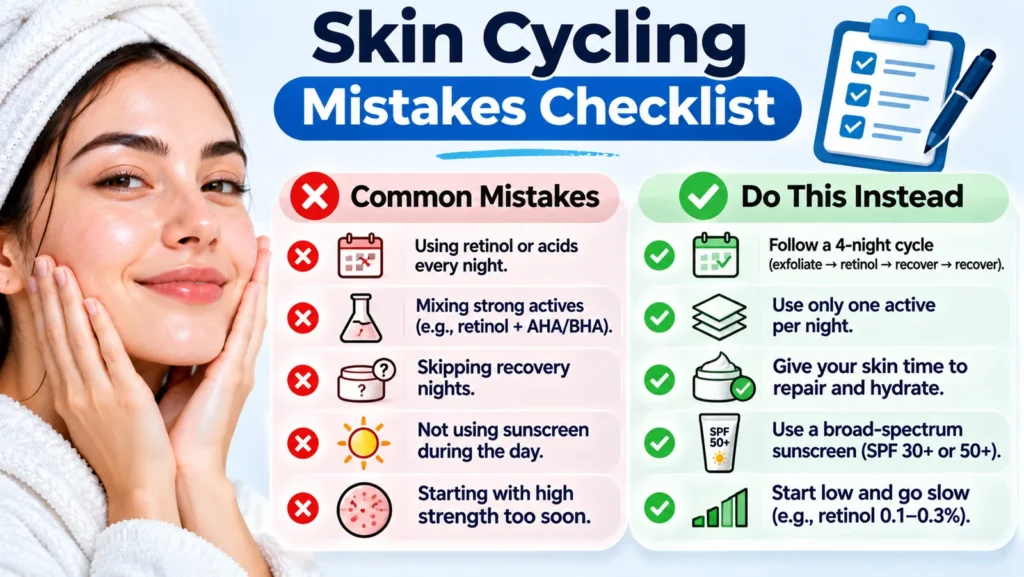
- Using retinol and exfoliating acids on the same night. Keep them on separate nights.
- Skipping recovery nights because skin “feels fine”. Rest nights are the point.
- Starting with a high-strength retinol. Begin low.
- Forgetting sunscreen. This is the most important step of all.
- Applying products to wet skin. For retinol, wait until your skin is fully dry to reduce irritation.
- Changing everything at once. Introduce one new product at a time.
- Not patch testing. Try new products on a small area first.
When to stop and get advice
Stop the active nights and see your GP or pharmacist if you notice:
- burning, intense redness or swelling
- peeling that does not settle after a few recovery nights
- a rash or hives
- skin that feels raw even after resting
Frequently asked questions
How long does skin cycling take to work?
Most people need about 8 to 12 weeks to notice changes, because retinoids and exfoliants work gradually.
Can I do skin cycling in the morning?
It is designed for evenings. Retinoids and exfoliants are usually used at night, and sunscreen is used in the morning.
Can I use vitamin C in a skin cycling routine?
Many people use vitamin C in the morning and keep the active nights at night. If your skin is sensitive, introduce it slowly.
Is skin cycling safe for sensitive skin?
It is often suggested for beginners and sensitive skin because it limits how often you use strong ingredients, but it is not risk-free. Patch test, start slowly, and speak to a professional if you have a skin condition.
How many times a week should I use retinol?
In a standard skin cycling routine, once every four nights. That is about twice a week.
Can I use a physical scrub instead of an acid?
Chemical exfoliants are generally gentler than rough scrubs, so beginners usually do better with those.
The bottom line
Skin cycling turns a confusing skincare shelf into a simple pattern: exfoliate, retinoid, rest, rest. Start slowly, protect your skin with SPF, and let your skin tell you what it needs. If you are unsure, a quick chat with a pharmacist is a good place to start.

Writer & Blogger
Aiman Shahzadi writes and edits GlowCulture's guides on beauty, skincare, health, fashion and lifestyle, turning research and reputable sources into clear, practical advice.
Leave a comment