



By Aiman Shahzadi, Founder & Senior Lifestyle Writer | Fashion | Last updated August 2026
A capsule wardrobe is a small, curated set of versatile pieces that mix and match effortlessly – cutting decision fatigue, reducing waste, and meaning you always have something to wear. Start with 25–30 core items, build around a neutral colour palette, and add seasonal pieces as needed.
For more on this, see our guides to how to dress more expensive on a budget, fashion tips for looking more put-together and sustainable fashion brands worth your money.
TL;DR
- A capsule wardrobe typically holds 25–35 pieces – enough variety without the overwhelm.
- Build on a neutral base (black, white, navy, camel, grey) and add one or two accent colours.
- The non-negotiable wardrobe essentials for women: a white shirt, tailored trousers, a blazer, a great coat, and quality denim.
- UK high-street brands – M&S, Next, Arket, COS, & Other Stories – cover every budget from £29 to £200 per piece.
- A sustainable approach (secondhand first, buy-less-buy-better) actively reduces the UK’s fashion footprint: extending garment life by just nine months cuts carbon, waste, and water use by 20–30% (UK Parliament Environmental Audit Committee).
- This guide covers every lifestyle – office, remote work, travel, parenting, creative work, and cultural/modest dressing.
What is a capsule wardrobe?
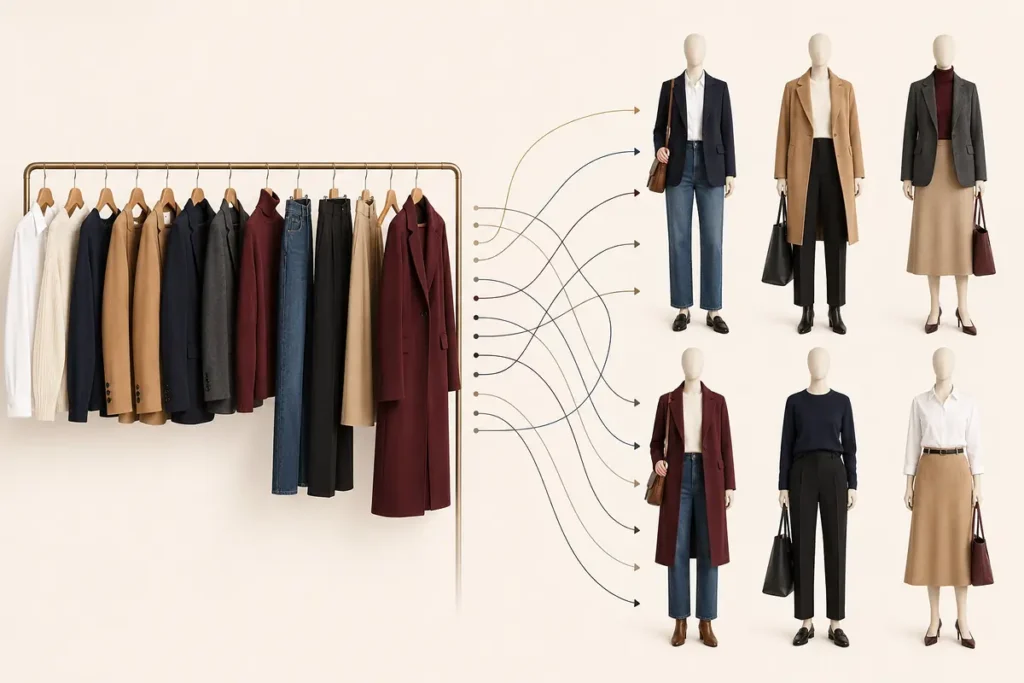
A capsule wardrobe is a deliberately small collection of clothes where every piece earns its place. Nothing sits unworn. Everything coordinates. The goal isn’t minimalism for its own sake – it’s intentionality. You choose fewer things, but better ones, and you wear them more.
The idea is simple: a neutral foundation of timeless wardrobe basics, topped up with a handful of seasonal or trend-led pieces each year. The result is a wardrobe that’s easier to dress from, cheaper to maintain over time, and far less wasteful.
A brief history (Susie Faux, Donna Karan)
The term was coined in the 1970s by Susie Faux, who owned a London boutique called Wardrobe. She described a capsule as a few essential garments – skirts, trousers, coats – that don’t go out of fashion, supplemented with seasonal additions. The concept had roots in American publications as far back as the 1940s, but Faux gave it a name and a practical framework.
It went mainstream in 1985 when Donna Karan launched her Seven Easy Pieces collection: seven interchangeable garments designed to take a woman from boardroom to evening without changing. Karan didn’t invent the capsule wardrobe, but she proved it could be commercially compelling – and the idea has never really left fashion conversation since.
Capsule wardrobe vs. minimalist wardrobe – what’s the difference?
People use these terms interchangeably, but they’re not the same thing.
| Capsule wardrobe | Minimalist wardrobe | |
|---|---|---|
| Goal | Versatility and outfit variety | Owning as little as possible |
| Typical size | 25–40 pieces | Often under 20 pieces |
| Seasonal updates | Yes – small additions each season | Rarely |
| Style focus | Mix-and-match coordination | Simplicity and reduction |
| Who it suits | Most women with varied lives | Those who want maximum simplicity |
A minimalist capsule wardrobe is the most stripped-back version – think a 10-piece travel wardrobe or a Project 333 challenge. A standard capsule wardrobe gives you more room to breathe. Neither is better; they just suit different lives.
How many pieces should a capsule wardrobe have?
There’s no magic number, and anyone who tells you otherwise is selling something.
That said, most women land somewhere in this range:
- 10–15 pieces – ultra-minimal, works for very simple lifestyles or as a travel capsule
- 20–25 pieces – a tight seasonal capsule, ideal if your life doesn’t vary much
- 25–35 pieces – the sweet spot for most women; covers work, weekends, and evenings
- 35–50 pieces – a fuller wardrobe with more occasion and seasonal coverage
We’d suggest starting at 30 pieces for your first capsule wardrobe. That’s enough to build real outfit variety – roughly 30 × 30 combinations if pieces are well-chosen – without the overwhelm of starting from scratch with 100 items.
The number matters less than the ratio of wearability: if you’re not reaching for something at least once a month, it’s not earning its place.
The essential capsule wardrobe pieces for women
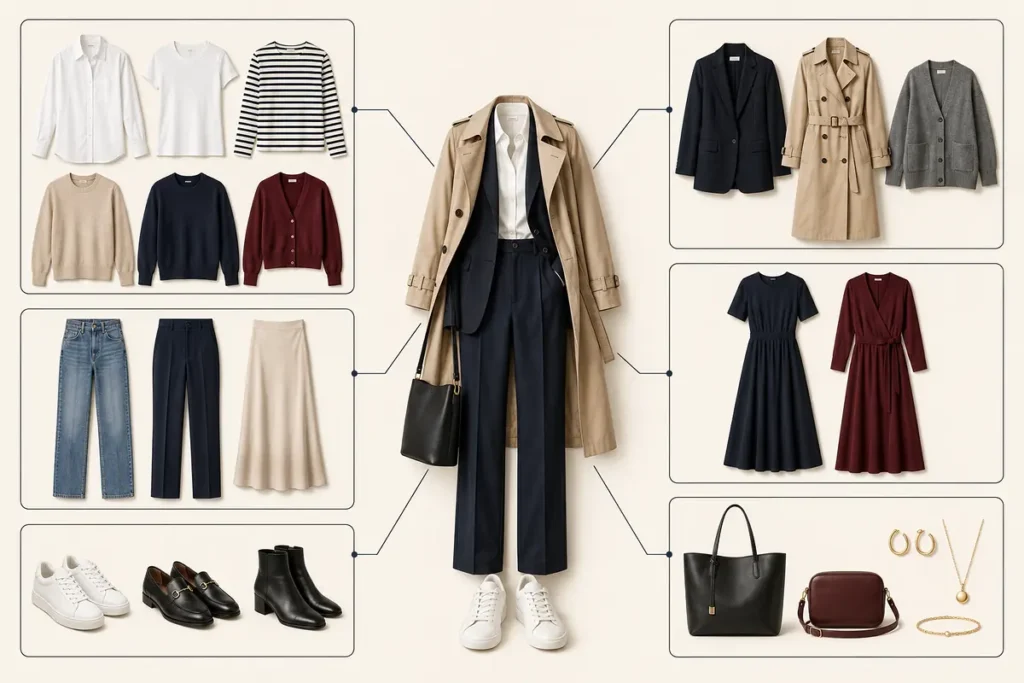
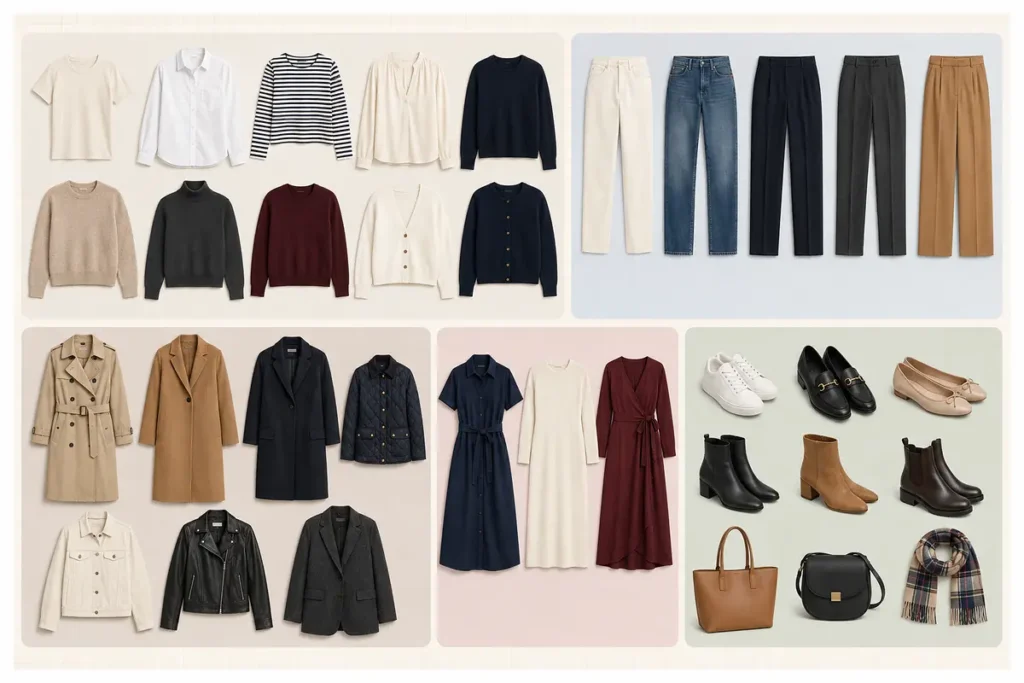
These are the capsule wardrobe essentials that appear in virtually every style guide, every lifestyle, every decade. They’re not trends. They’re the architecture.
Tops & knitwear
- White fitted T-shirt (2) – the most-worn item in any wardrobe
- White or pale blue button-front shirt – works tucked, untucked, open over a tee
- Fine-knit crewneck or V-neck jumper (2, different weights) – M&S does these brilliantly from around £35
- Striped Breton top – a British wardrobe staple that never really goes out
- Lightweight long-sleeve top – for layering under blazers or over tees in spring/autumn
Bottoms
- Straight-leg or wide-leg jeans – the 2026 silhouette leans wide; dark indigo is the most versatile wash
- Tailored trousers – mid or high-rise, in black or camel; COS does a good wool-blend at around £115
- Midi skirt – a-line or straight cut, in a neutral; pairs with everything above
- Shorts or casual trousers – one pair for warmer months
Layers & outerwear
- Longline blazer – the single hardest-working piece in a capsule; wear over dresses, trousers, jeans
- Classic trench coat – a British essential; M&S and Next both do reliable versions under £150
- Lightweight jacket – denim, leather, or quilted depending on your style
- Cosy knit cardigan – for layering at home, in the office, or over dresses
Dresses & jumpsuits
- Midi wrap dress – flattering across body types, dresses up or down easily
- Simple shift dress or tailored dress – for work or smart-casual occasions
- Casual jersey dress or sundress – weekends and warmer months
Shoes
- White trainers – the most-worn shoe in the UK right now
- Loafers or ballet flats – smart-casual, office-ready, comfortable
- Ankle boots – block heel or flat; the British autumn/winter essential
- Heeled sandals or mules – for evenings and summer
Bags & accessories
- Structured tote or work bag – large enough for a laptop, polished enough for meetings
- Crossbody bag – for weekends and travel
- Belt (1–2) – instantly updates an outfit; a tan leather belt works with almost everything
- Simple gold or silver jewellery – a few pieces, not a collection
What colours work best in a capsule wardrobe?
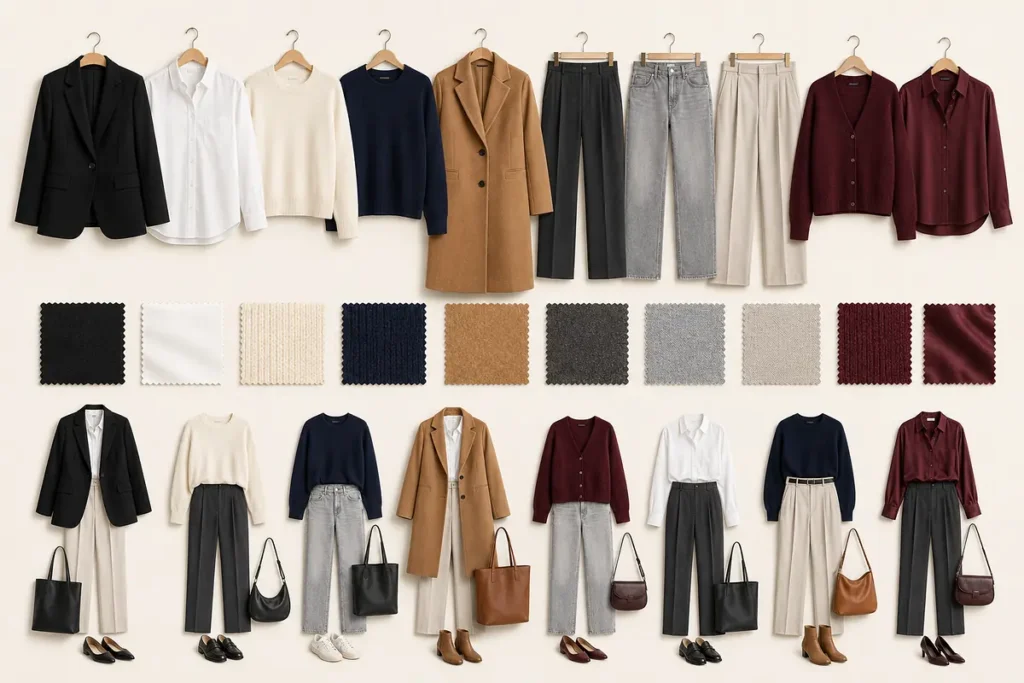
Colour is where most capsule wardrobes succeed or fail. Get it right and everything works together. Get it wrong and you have 30 beautiful pieces that don’t talk to each other.
Building a neutral base
Your base palette should cover 70–80% of your wardrobe. The most versatile neutrals for a capsule wardrobe UK context – where the weather is grey more often than not – are:
| Neutral | Why it works |
|---|---|
| Black | Pairs with everything; professional; slimming |
| White / Ivory | Brightens; works in every season |
| Navy | Softer than black; very British; works in workwear and casual |
| Camel / Tan | Warm, elevated; pairs beautifully with black, white, and navy |
| Grey (mid or charcoal) | Versatile; great for knitwear and tailoring |
| Stone / Ecru | Quiet luxury; works year-round in the UK |
Pick three or four of these as your base. Don’t try to build on all six – your wardrobe will feel muddy rather than cohesive.
Adding your accent colour
Your accent colour is 20–30% of your wardrobe – a few pieces that give your outfits personality. In 2026, the most wearable accent colours are:
- Burgundy / deep red – works across autumn/winter and into spring
- Forest green – pairs with camel, navy, and black; very wearable in the UK
- Cobalt or French blue – a strong summer accent that reads as sophisticated, not garish
- Rust / terracotta – warm, earthy, flattering on a wide range of skin tones
One accent colour is enough. Two if they’re in the same family (burgundy and rust, for example).
How to build a capsule wardrobe by season (UK)
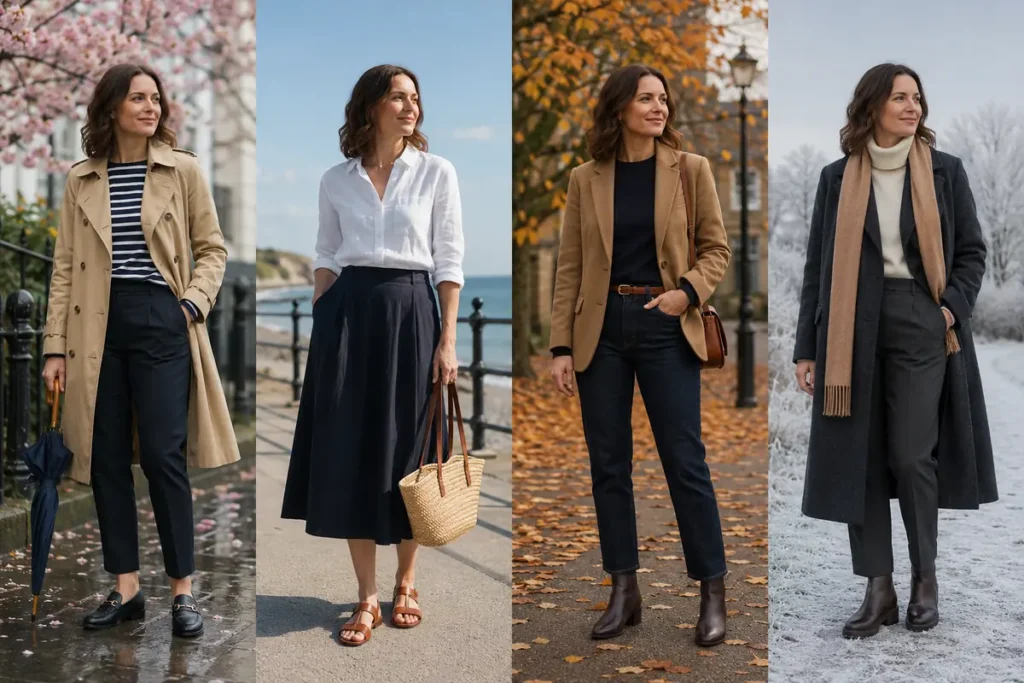
The UK’s four seasons are real but unpredictable. A British summer can feel like autumn by August; a March day can be warmer than June. Build your capsule around layering, not temperature.
Spring (March–May)
Spring in the UK means 8°C mornings and 18°C afternoons. Layering is everything.
Add: Lightweight trench coat, Breton tops, midi skirts, loafers, white trainers. Retire: Heavy knitwear, thick wool coats, thermal layers. Key pieces: A linen or cotton-blend shirt, a light cardigan, a transitional midi dress.
Summer (June–August)
British summers are brief and variable. Don’t invest heavily – a few well-chosen pieces go further than a full summer wardrobe.
Add: Linen trousers, sundresses, sandals, a lightweight denim jacket for evenings. Retire: Boots, heavy coats, thick knitwear. Key pieces: A linen shirt (doubles as a beach cover-up), a jersey midi dress, white trainers.
Autumn (September–November)
The best season for capsule dressing. Layers work beautifully, and the palette naturally shifts to warmer tones.
Add: Ankle boots, chunky knitwear, a wool-blend blazer, cord or denim trousers. Retire: Sandals, sundresses, linen. Key pieces: A camel coat or longline blazer, a fine-knit roll-neck, dark-wash jeans.
Winter (December–February)
Comfort and warmth without sacrificing polish. The key is a great coat and quality knitwear.
Add: A structured wool coat, thermal underlayers (worn under your capsule pieces), knee-high boots. Retire: Linen, lightweight cotton, sandals. Key pieces: A cashmere or merino jumper (M&S has excellent options under £100), a longline coat, tailored trousers.
How to build a capsule wardrobe on a budget
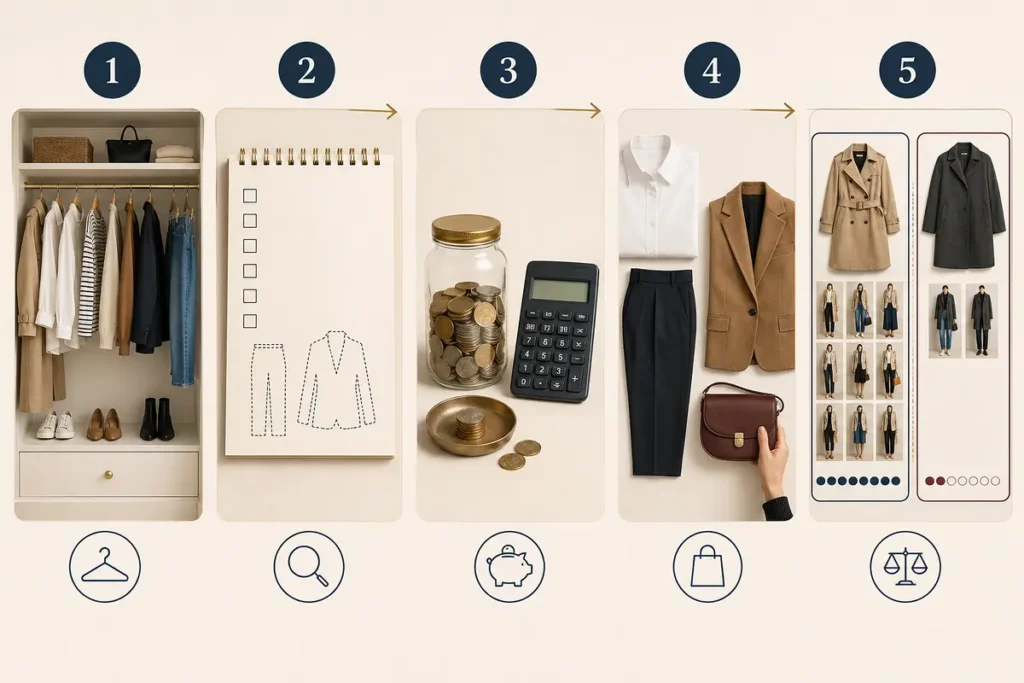
A capsule wardrobe doesn’t require a designer budget. It requires patience and strategy.
Step 1: Audit what you already own. Before buying anything, pull everything out. You’ll almost certainly find 5–10 pieces that belong in a capsule – they’ve just been buried.
Step 2: Identify the gaps. Write a list of the specific pieces missing from your capsule. Not “more tops” – “a white fitted T-shirt in size 14” or “black tailored trousers with a mid-rise.”
Step 3: Set a realistic budget. A functional 25-piece capsule from UK high street brands costs roughly:
- £200–£400 if you shop M&S and Next carefully, use sales, and mix in secondhand
- £400–£700 if you lean toward Arket and COS for anchor pieces
- Under £150 if you go primarily secondhand (Vinted, Depop, local charity shops)
Step 4: Buy in the right order. Start with the pieces you’ll wear most – a good pair of trousers, a white shirt, a blazer. Resist buying the fun accent pieces first.
Step 5: Use the cost-per-wear test. A £120 M&S trench coat worn 80 times costs £1.50 per wear. A £30 fast-fashion coat worn 8 times costs £3.75. Quality wins over time.
UK high-street quick reference:
- M&S – best for shirts, knitwear, trench coats; cashmere under £100
- Next – broad range; excellent in sales; good boots and outerwear
- COS – clean, architectural basics; tailored trousers from £115, blazers from £159
- Arket – elevated basics; jeans around £97, quality knitwear
- & Other Stories – great for accessories and statement basics; slightly more trend-led
Where to source a capsule wardrobe sustainably
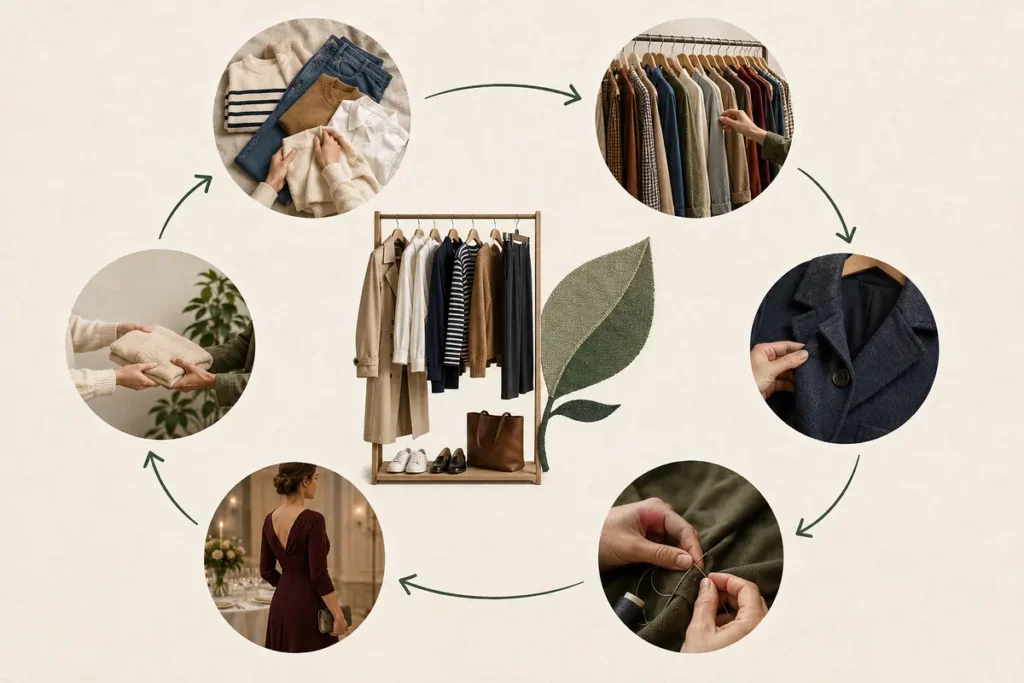
The UK disposes of over one million tonnes of clothing every year (UK Parliament Environmental Audit Committee, 2019 – the scale hasn’t improved significantly since). Fast fashion still accounts for roughly 45% of UK textile consumption. A capsule wardrobe is one of the most practical responses to that.
Secondhand first:
- Vinted – the UK’s largest peer-to-peer clothing platform; excellent for branded basics
- Depop – better for vintage and more distinctive pieces
- eBay – underrated for quality high-street and designer pieces; use “sold” listings to check real prices
- Local charity shops – particularly good in affluent areas; Oxfam boutiques in cities are worth a visit
Rental for occasions:
- Hurr and By Rotation are UK-based fashion rental platforms – ideal for one-off events so you don’t break the capsule
When buying new:
- Look for GOTS-certified organic cotton, Oeko-Tex certified fabrics, or recycled materials
- Brands with credible sustainability credentials – and there are more than you’d think – include Thought Clothing, People Tree, Patagonia (for outerwear), and Arket (H&M Group’s most transparent brand). For a broader directory, our roundup of sustainable fashion brands covers the UK market in detail
- Avoid greenwashing: a “sustainable collection” from a fast-fashion brand is not the same as a brand built around responsible production
The buy-less-buy-better principle: extending the life of a garment by just nine months reduces its carbon, water, and waste footprint by 20–30%. That’s the entire logic of a capsule wardrobe in one statistic.
Build your capsule by lifestyle
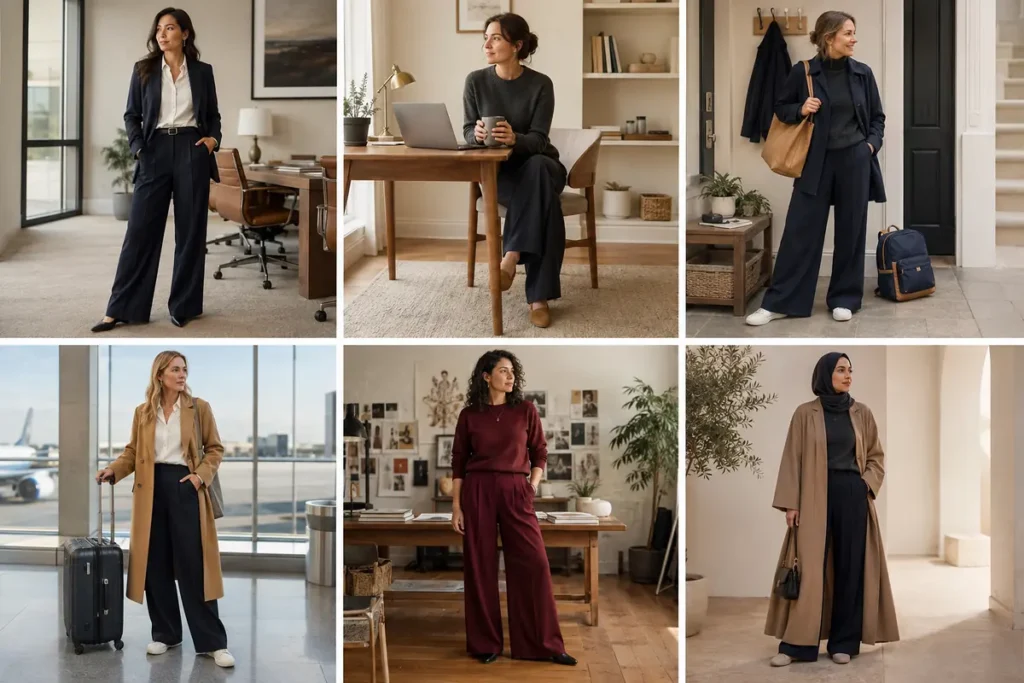
The wardrobe basics are the same for everyone. How you weight them depends on how you actually live.
The office capsule wardrobe (workwear)
A workwear capsule wardrobe lives or dies on tailoring and layering. The core: two pairs of tailored trousers (black and camel or navy), two blazers (one structured, one relaxed), three to four shirts or smart tops, one work dress, and quality shoes – loafers or low heels.
The formula that never fails: tailored trousers + shirt + blazer. Swap the shirt for a fine knit in winter; swap the blazer for a cardigan on casual Fridays.
The remote-work capsule
Comfort that still looks intentional on a video call. Focus on smart-casual tops (fine knits, neat shirts, Breton tops), comfortable but polished bottoms (wide-leg trousers, relaxed jeans), and one or two blazers you can throw on for calls. Loungewear is not part of a capsule wardrobe – it’s a separate category.
The parent capsule
Practicality without sacrificing self. The parent capsule prioritises washable fabrics (avoid dry-clean-only), dark or mid-tone colours (navy, forest green, charcoal – not white linen), and comfortable but structured silhouettes. Wide-leg trousers and a good knit are the parent capsule’s best friends. Avoid anything with delicate embellishment.
The traveller capsule
The most minimal version of a capsule wardrobe – typically 10–15 pieces that fit in a carry-on. The rules: every piece must work with at least three others, fabrics must be wrinkle-resistant (merino wool, ponte, linen blends), and shoes are limited to three pairs maximum. A longline blazer doubles as a travel layer and a smart evening piece.
The creative capsule
Creative industries allow more self-expression, but a capsule still helps. Lean into one or two signature elements – a bold colour, an interesting texture, a distinctive silhouette – while keeping the rest neutral. The capsule wardrobe ideas that work best here: a great pair of wide-leg trousers in an unexpected colour, a few quality basics, and accessories that do the talking.
The cultural capsule – bridging Western and cultural dress codes
This is the section most style guides skip entirely. They shouldn’t.
Many women in the UK dress across two or more cultural contexts – a Western professional environment during the week, family occasions or religious observance at weekends, and everything in between. The good news: the most versatile capsule wardrobe pieces are also the most culturally adaptable.
Wide-leg trousers are professional, modest, and comfortable – they work in a boardroom and at a family gathering. Longline blazers provide coverage without looking like a compromise; they’re simply good tailoring. Maxi skirts in neutral tones are elegant in any context. Layering-friendly tops – longer-length blouses, fine-knit tunics, structured shirts – give you the flexibility to add or remove a layer depending on the setting.
For women who wear hijab or prefer full coverage: a breathable abaya in a neutral tone (black, navy, stone) is one of the most versatile pieces you can own. Worn over tailored trousers and a fine knit, it reads as polished and professional in any UK workplace. Paired with a maxi skirt and structured top, it works for formal occasions. The abaya isn’t a compromise – it’s a capsule piece.
The principle is the same as for any capsule: choose pieces that do more than one job. A longline blazer that works in a meeting and at an Eid gathering is a better investment than two separate pieces. A maxi skirt that works at Friday prayers and at a work dinner earns its place twice over.
This isn’t about flattening cultural identity into a Western template. It’s about recognising that many women already navigate these contexts with skill – and that the capsule wardrobe framework supports that, rather than ignoring it. If you want to go deeper on how beauty standards around the world shape what we wear and how we see ourselves, that’s worth a read alongside this guide.
Common mistakes to avoid
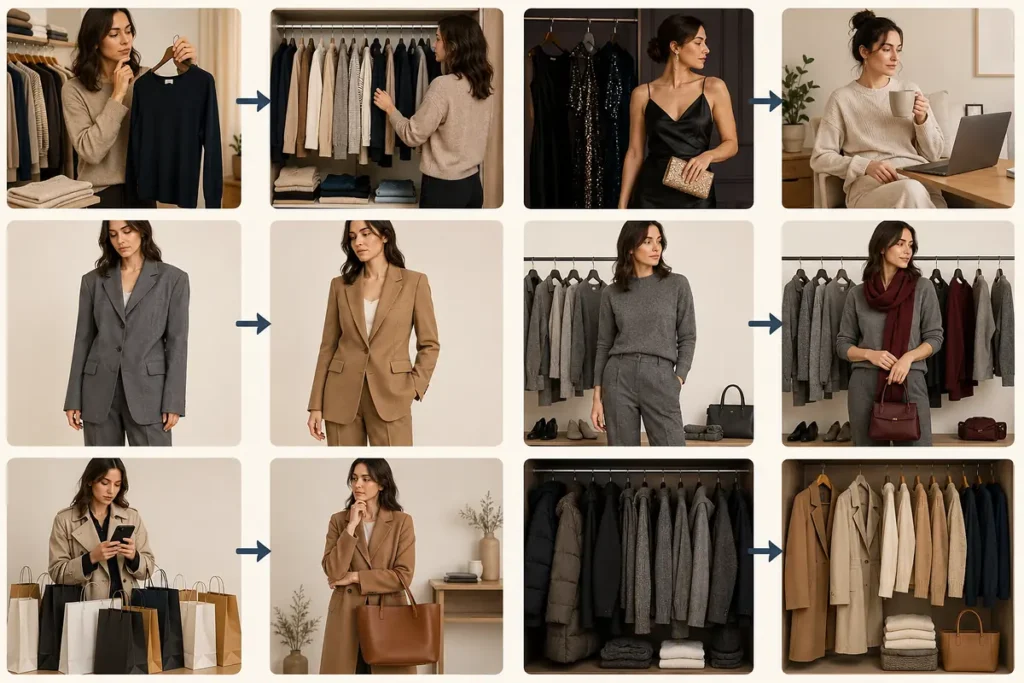
Buying the capsule before auditing the existing wardrobe. You almost certainly already own some of the pieces. Start there.
Choosing aspirational pieces over real-life ones. A capsule wardrobe should reflect the life you actually live, not the one you imagine. If you work from home four days a week, you don’t need five work blazers. There’s also a real mental-load cost to a wardrobe that doesn’t match your life – the daily friction of getting dressed is a genuine source of stress, and good stress management starts with removing unnecessary decisions from your morning.
Ignoring fit. A poorly fitting piece in a neutral colour is still a poorly fitting piece. Fit matters more in a capsule than in a full wardrobe – there’s nowhere to hide.
Going too neutral. A capsule wardrobe of all-grey and all-black can feel oppressive. One or two accent pieces make the whole wardrobe feel intentional rather than institutional.
Buying everything at once. Build gradually. Wear what you have, identify the gaps, then fill them deliberately.
Treating the capsule as fixed. A capsule wardrobe should evolve with your life. Review it twice a year – once in spring, once in autumn – and edit accordingly.
Frequently asked questions
What is the ideal starter size for a capsule wardrobe? Start with 25–30 pieces. That’s enough to build real outfit variety without overwhelming yourself. You can always edit down or add specific pieces once you’ve worn the capsule for a season and know what’s missing.
How much does a capsule wardrobe cost? It depends entirely on where you shop. A functional 25-piece capsule from UK high street brands (M&S, Next) costs roughly £200–£400 if you shop sales and mix in secondhand pieces. Leaning toward Arket or COS for anchor pieces pushes that to £400–£700. Going primarily secondhand via Vinted or charity shops can bring it under £150.
What colours should I choose for a capsule wardrobe? Build on three or four neutrals – black, white, navy, and camel are the most versatile combination for the UK. Add one accent colour (burgundy, forest green, or cobalt are strong choices for 2026). Everything should work with everything else.
How often should I refresh a capsule wardrobe? Twice a year is the standard rhythm – a light edit in spring (swap heavy outerwear for lighter layers) and in autumn (bring back knitwear and boots). You’re not replacing the whole wardrobe; you’re swapping out 5–8 seasonal pieces.
Can a capsule wardrobe work for plus-size women? Absolutely. The principles are identical – versatile pieces, neutral base, good fit. The practical difference is sourcing: not every high-street brand offers the same range in extended sizes. M&S and Next both carry capsule-worthy pieces up to a size 32; ASOS Curve and Simply Be are worth bookmarking for specific gaps.
What’s the difference between a capsule wardrobe and a minimalist wardrobe? A capsule wardrobe prioritises versatility – pieces that mix and match across multiple outfits. A minimalist wardrobe prioritises reduction – owning as little as possible. A minimalist capsule wardrobe is the overlap: very few pieces, all highly versatile. Most women are better served by a standard capsule (25–35 pieces) than a strict minimalist approach.
How do I build a capsule wardrobe on a low budget? Start with what you already own. Audit your wardrobe, identify the 10–15 pieces that already belong in a capsule, and only buy what’s genuinely missing. Shop secondhand first (Vinted, Depop, charity shops). When buying new, prioritise the pieces you’ll wear most – a good white shirt and a pair of tailored trousers will serve you better than five trend pieces at the same price.
Does a capsule wardrobe work for modest dressing? Yes – and arguably better than a conventional wardrobe. Wide-leg trousers, longline blazers, maxi skirts, and layering-friendly tops are all capsule staples that also work beautifully within modest dress codes. A neutral-toned abaya is one of the most versatile pieces you can own. See the cultural capsule section above for a full breakdown.
Useful sources
- Wikipedia: Capsule wardrobe – history and origins
- UK Parliament Environmental Audit Committee: Fixing Fashion report
- The Good Trade: What is a capsule wardrobe?
- Elle UK: Capsule wardrobe essentials 2026
Related reading on GlowCulture
- Skincare rituals from around the world – how different cultures approach skin health, from Japanese double-cleansing to Ayurvedic oil rituals
- Stress-relief skincare ingredients – the actives that genuinely calm skin when life gets hectic
- Beauty standards around the world – how global perspectives shape what we wear and how we see ourselves
- Skincare routine for your skin type – build a routine as intentional as your wardrobe, matched to what your skin actually needs
- Does stress cause wrinkles? – the science behind the stress–skin connection, and what you can do about it