By Aiman Shahzadi | Culture | 12 min read | Last updated November 2026
TL;DR
Beauty Standards Around the World have fascinated people for centuries because every culture defines beauty in its own unique way. From the glowing skin ideals of East Asia to the rich beauty traditions of South Asia, the natural hairstyles celebrated in West Africa, and the confidence-focused trends of Latin America and the West, beauty standards around the world continue to evolve. In this guide, you’ll discover how different cultures define beauty, why these ideals change over time, and what they can teach us about self-confidence and diversity.
For more on this, see our guides to beauty tips that make your routine easier and K-beauty inspired eye makeup trends.
East Asia (Japan, Korea, China) has long prized pale, even-toned “glass skin” and small, youthful facial features.
West Africa and parts of the Middle East (Mauritania, Nigeria) historically valued fuller figures as a marker of health and prosperity.
Latin America (Brazil) tends to celebrate curvier, athletic bodies and tanned skin.
Western Europe/North America has cycled through curvy (1950s), waif-thin (1990s), athletic (2010s), and now a more body-neutral standard, largely driven by media and advertising.
All of these ideals shift over time – none is fixed, and none is “correct.” Body positivity and inclusive beauty movements exist precisely because no single standard reflects most real bodies.
This guide walks through how beauty ideals differ by region, why they change, and what the body-positivity movement is actually pushing back against – with a respectful, sourced comparison across five cultures.
What are “beauty standards” and why do they differ by culture?

Understanding beauty standards around the world helps us appreciate cultural diversity instead of comparing ourselves with unrealistic ideals.Beauty standards are the shared, often unspoken ideas a society holds about what makes a face or body attractive. They’re not biological facts – they’re cultural agreements, and they shift as economics, media, and power structures shift.
Researchers who study attractiveness generally agree on two things:
A handful of traits (facial symmetry, clear skin) show up as broadly appealing across many cultures, likely tied to basic health signalling.
Everything else – body size, skin tone preference, hair texture, specific facial features – is shaped locally, by history, colonialism, media exposure, and economic conditions.
That second point is why beauty standards around the world look so different depending on where you stand. A trait read as high-status in one place (pale skin in parts of East Asia, historically linked to not needing to work outdoors) can be read as a marker of leisure and wealth in one century and be irrelevant, or even reversed, in another.
How do beauty ideals differ by region?
Here’s a grounded look at recurring patterns researchers and cultural writers have documented – described as tendencies, not rules, since individual preference varies enormously within every culture.
East Asia (Japan, South Korea, China)East Asian beauty trends are among the most influential beauty standards around the world, inspiring skincare and makeup routines globally. Pale, even “glass skin,” a small face, and large, youthful eyes have dominated beauty media for decades. South Korea’s skincare-led beauty industry – the root of the global “K-beauty” boom – reflects this emphasis on skin texture over heavy makeup. Interestingly, Japan’s yaeba trend (a slightly uneven, “fanged” smile) shows that even within one country, ideals can run counter to symmetry-first assumptions.

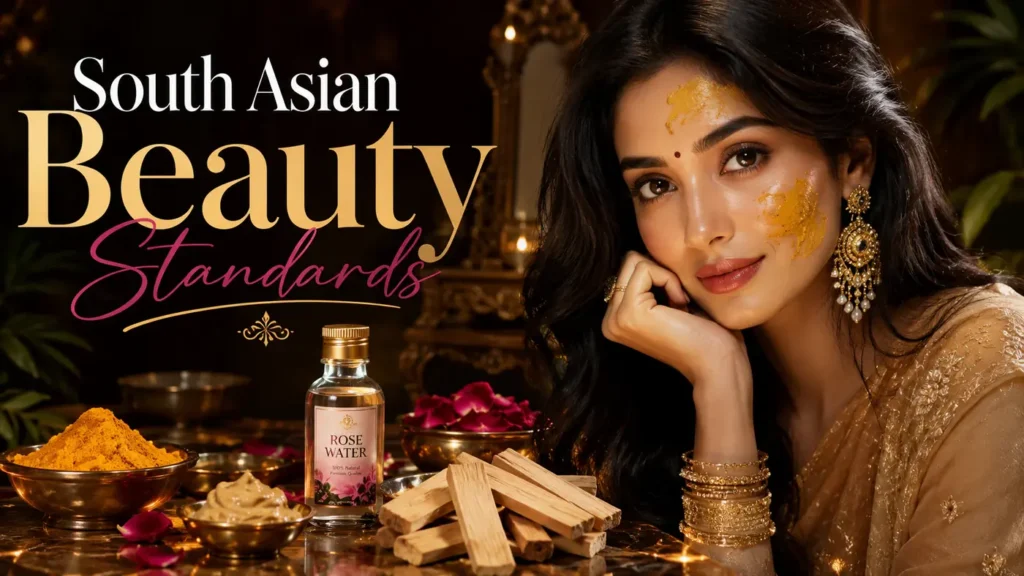
South Asia (India)Traditional South Asian beauty rituals have shaped beauty standards around the world through natural ingredients and timeless self-care practices. Fair skin, thick dark hair, and expressive eyes have historically been prized, and skin-lightening products remain a large commercial category. At the same time, there’s a visible, growing pushback – Indian celebrities and campaigns increasingly champion deeper natural skin tones, partly in response to colourism criticism.
West Africa (Mauritania, Nigeria) West African traditions continue to enrich beauty standards around the world by celebrating natural hair, bold fashion, and cultural identity. In Mauritania, a tradition called leblouh has historically encouraged fuller body weight in girls and women as a sign of prosperity and marriageability, a practice public health bodies have also raised concern about. Across much of West Africa more broadly, curves, confident presence, and elaborate hair styling are longstanding markers of beauty, running counter to the thin ideal common in Western media.
Latin America (Brazil)Today, beauty standards around the world are becoming more inclusive, encouraging people to embrace individuality, confidence, and authentic beauty. Brazil’s beauty culture tends to celebrate a curvier, toned physique, tanned skin, and grooming as an everyday ritual rather than a special occasion. Brazil is also one of the largest markets globally for cosmetic procedures, reflecting how deeply body ideals are tied to social norms there.
Western Europe & North America This is the region with the most well-documented change over time: fuller, corseted figures in the Renaissance; the athletic “Gibson Girl” around 1900; flapper thinness in the 1920s; hourglass curves in the 1950s; heroin-chic thinness in the 1990s; the fitness-driven, curvier-but-toned “Instagram body” of the 2010s. Mass media and, more recently, social platforms accelerate these cycles far faster than pre-20th-century shifts ever moved.
Comparison table: beauty ideals across five cultures
Region | Historically valued traits | Common practices/rituals | What’s shifting now |
|---|---|---|---|
East Asia (Japan, S. Korea, China) | Pale, even skin; small face; youthful features | Multi-step skincare, sun avoidance, some cosmetic procedures | Growing embrace of “skinimalism” and skin health over heavy correction |
South Asia (India) | Fair skin; thick hair; expressive eyes; fuller figure historically tied to prosperity | Oiling rituals, henna, skin-lightening products | Rising pushback against colourism; more darker-skinned representation in media |
West Africa (Mauritania, Nigeria) | Fuller figure as a sign of health/status; bold hair styling | Leblouh feeding tradition (Mauritania); elaborate braiding | Public health debate over feeding practices; natural hair movement gaining ground |
Latin America (Brazil) | Curvy, toned physique; tanned skin | Daily grooming rituals, high rate of cosmetic procedures | Body neutrality conversations entering mainstream media |
Western Europe/N. America | Cycles: curvy → thin → athletic → body-neutral | Dieting culture, gym culture, filtered social media | Body positivity, size-inclusive fashion, “no-makeup” trend |
Sourcing note: this table reflects patterns documented by cultural researchers, journalists, and public health bodies (see Sources below). These are broad regional tendencies, not universal rules – individual preferences and body types within every culture vary widely, and none of these traditions define what any specific person “should” look like.
How have beauty standards changed throughout history?
Beauty ideals in the West alone have swung repeatedly in just the last 600 years:
Renaissance (1400s–1600s): Fuller figures, high foreheads, and pale skin signalled leisure and status – tanned skin meant outdoor labour.
Victorian era (1800s): Corseted waists and pale complexions remained the standard; cosmetics were still viewed with suspicion.
1920s: The flapper look – short hair, flattened chest, boyish silhouette – broke sharply from the corseted hourglass.
1950s: Hourglass curves returned, epitomised by stars like Marilyn Monroe.
1990s: “Heroin chic” – extreme thinness – became fashion’s dominant look.
2010s–2020s: Fitness culture and social media pushed a toned-but-curvy “Instagram body,” followed by a partial correction toward body neutrality and inclusive sizing.
The pattern that repeats: whichever body type is hardest to achieve for most people tends to become the era’s status symbol. That’s worth sitting with, because it explains a lot about why standards keep moving instead of settling.
What is the body positivity movement, and how does it connect to beauty standards?
The body positivity movement pushes back directly against the idea that there’s one correct body type or beauty ideal.
Its roots go back further than most people assume:
The fat acceptance movement began in the late 1960s in the US – engineer Bill Fabrey founded the National Association to Aid Fat Americans (now NAAFA) in 1969 after witnessing discrimination against his wife.
Fat Underground, a group of West Coast feminists, published the “Fat Manifesto” in 1973, explicitly framing thinness-as-ideal as a form of discrimination.
The movement’s foundations were shaped significantly by fat, queer, Black women, who created space for bodies excluded by mainstream media.
The Body Positive organisation, founded in 1996 by Connie Sobczak and Elizabeth Scott, helped formalise body-acceptance education.
The term “body positivity” went mainstream on Instagram around 2012–2014, expanding beyond fat acceptance to cover race, disability, gender identity, and skin conditions.
The connection to global beauty standards is direct: once you see how much beauty ideals vary by country and decade, the case for treating any single one as objectively “correct” gets a lot weaker. That’s the entire argument body positivity and body neutrality movements are built on.
Is beauty subjective, or are some traits universal?
Both, in different proportions.
What tends to be broadly consistent across cultures:
Facial symmetry
Clear, healthy-looking skin
Signs of good health generally (bright eyes, healthy hair)
What varies heavily by culture and era:
Ideal body size and shape
Skin tone preference
Hair texture and styling
Specific facial feature preferences (eye shape, nose shape, lip fullness)
Research bodies like Dove’s Global Beauty and Confidence studies have repeatedly found that most girls and women don’t feel their appearance matches whatever standard is dominant in their culture at the time – which says less about any individual and more about how narrow and fast-moving these standards tend to be.
Why does understanding beauty standards around the world matter?
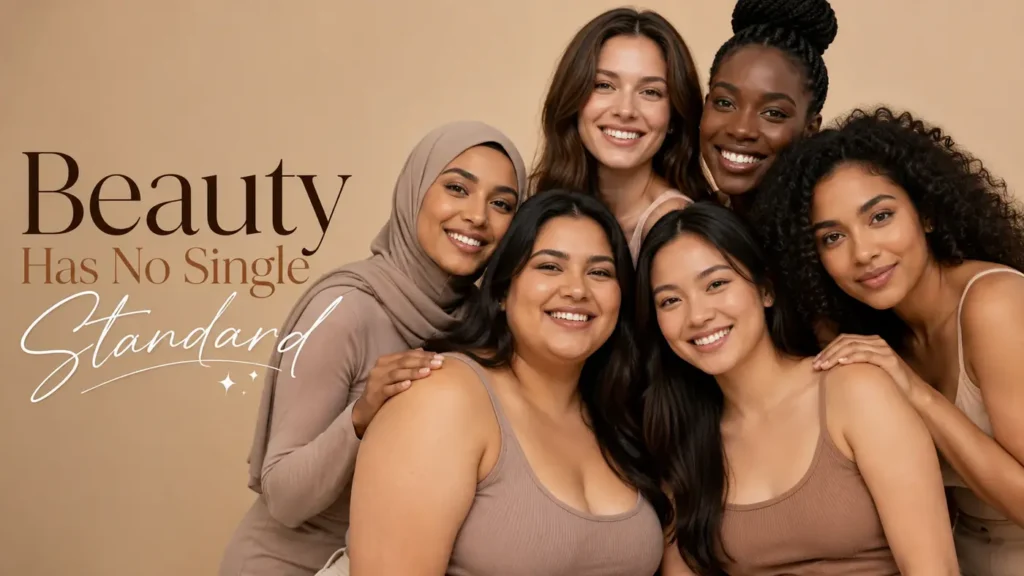
Because comparing beauty traditions across cultures – respectfully, and with sourcing – does two useful things:
It shows that no beauty standard is neutral or “natural.” Each one reflects specific economic and historical conditions.
It gives people a wider frame of reference than whatever single ideal their own media environment pushes, which is a documented factor in body image and self-esteem, particularly among teenagers.
None of this is about ranking cultures or traditions against each other. It’s simply useful to know that the “ideal” you’re measuring yourself against today is one of many, and it won’t look the same in twenty years.
Is beauty universal? What the research says
Researchers have found more agreement across cultures than the “beauty is only cultural” view suggests. A widely cited review by Langlois and colleagues (Psychological Bulletin, 2000) reported that people from different cultures tend to agree on who is attractive. A later study by Gottschall and colleagues (Human Nature, 2008) analysed folktales from around the world and found that the emphasis on looks fell mainly on women across cultures. Agreement is strongest for broad cues such as healthy-looking skin and symmetry; body size, skin tone and hair preferences vary far more and shift with history, economics and media. Treat these findings as patterns across large groups, not rules about any individual.
Colourism and skin lightening: why pale skin is prized in some places
Preference for lighter skin is not only a style choice. Writers on the subject link it to colonial history and to caste and class hierarchies, where paler skin signalled status. A 2023 survey of South Asian Americans published in JMIR Dermatology found that 31% (55 of 175 respondents) reported using skin-lightening products, with parental pressure the strongest factor, and 60% of users reported adverse effects. The sample came from a Facebook group, so it does not represent everyone. In 2020 the brand Fair & Lovely was renamed Glow & Lovely after criticism of its messaging. If you are considering any lightening product, speak to a dermatologist first, because some unregulated creams contain harmful ingredients.
The same face, edited in different countries
In 2014 journalist Esther Honig sent one unretouched portrait to Photoshop freelancers in many countries and asked them to make it “beautiful”. The results varied widely and went viral (reported by TIME). It is a vivid illustration but not scientific: each result reflects one editor’s taste and skill, not a whole nation’s ideal.
How social media is changing beauty ideals
Filters, short video and global brands spread the same looks quickly, so ideals that were once local, such as very smooth “glass skin” or a particular brow shape, now travel across borders within months. At the same time, body-neutrality and natural-hair communities use the same platforms to push back. That is why some regional differences in the table above are narrowing in advertising while staying strong in everyday preference.
Frequently asked questions
What are beauty standards around the world? They’re the culturally specific ideas about attractiveness that dominate in a given region or era – things like preferred skin tone, body size, or facial features. They differ significantly by country and change over time, shaped by history, economics, and media rather than any fixed rule.
Which country has the most different beauty standard from the West? It depends on the trait. Mauritania’s historical leblouh tradition, which encouraged fuller body weight as a marker of prosperity, sits at the opposite end of the spectrum from the thin ideals that dominated Western fashion media in the 1990s and 2000s.
Do all cultures value the same things in beauty? No. Some traits (facial symmetry, clear skin) show up fairly consistently across cultures, but body size, skin tone preference, and specific facial features vary widely and are shaped by local history and economics rather than any universal rule.
What is the body positivity movement? It’s a movement, dating back to fat acceptance activism in the late 1960s, that pushes back against the idea of one “correct” body type or beauty standard, and instead promotes acceptance across body sizes, skin tones, and abilities.
Are beauty standards the same as they were 50 years ago? No. Even within a single country, ideals shift roughly every decade or two – Western beauty standards alone have moved through curvy, thin, athletic, and now more body-neutral phases just since the 1950s.
Is beauty subjective? Largely, yes. A small set of traits (symmetry, clear skin) reads as broadly appealing across cultures, but most specific preferences – body shape, skin tone, features – are culturally learned rather than fixed or universal.
Beauty standards around the world remind us that beauty is not defined by one culture or appearance. Every tradition offers unique values that celebrate confidence, self-expression, and diversity.
Why is pale skin preferred in some parts of Asia? Partly because of old links between paler skin and status (not having to work outdoors), and partly because of colonial and caste history. These ideas are increasingly challenged, for example by brand renames and campaigns for deeper skin tones.
Is beauty universal or cultural? Both. Research finds agreement across cultures on some cues such as healthy-looking skin, while body size, skin tone and hair preferences are shaped by local history and media.
Is there one country with the strictest beauty standards? No reliable ranking exists. Pressure depends on age, gender, media and community, so comparisons between countries are not trustworthy.
Related Reading
- Skincare Rituals from Around the World: Korean, Japanese & South Asian Beauty Secrets
- The Science Behind Glass Skin: Your Complete Guide — What Korean Dermatologists Actually Know (And The West Ignores)
- 21 Beauty Tips That Make Everyday Skin, Hair and Makeup Easier
- How to Do Facial Massage & Gua Sha at Home
Browse more in Culture.
Useful sources
- Langlois et al. (2000), Psychological Bulletin 126(3): Maxims or Myths of Beauty?
- Gottschall et al. (2008), Human Nature 19(2): The “Beauty Myth” Is No Myth
- TIME (2014): The same woman photoshopped in different countries
- Banala et al. (2023), JMIR Dermatology 6:e49068: skin-lightening product use
- D+C (2021): Why lighter complexions are associated with higher status