
How to choose Sunscreen?
Sunscreen is the one skincare step dermatologists agree on across every routine, yet most people either skip it, apply too little, or pick a formula that doesn’t suit their skin. How to choose sunscreen Here is a practical, source-backed guide to choosing and using sunscreen correctly.
SPF and Broad-Spectrum: What the Numbers Actually Mean
SPF measures protection against UVB rays, the ones that cause sunburn. SPF 30 blocks roughly 97% of UVB rays, while SPF 50 blocks about 98% — a small difference, which is why dermatologists say SPF 30 is the practical minimum rather than chasing higher numbers. To also claim UVA protection, a product must pass the FDA’s broad-spectrum test, which requires a critical wavelength of at least 370 nanometres. A sunscreen that doesn’t say “broad-spectrum” on the label has not been tested for UVA protection, regardless of its SPF how to choose sunscreen number.
Mineral vs Chemical Sunscreen

- Mineral (zinc oxide, titanium dioxide): sits on top of the skin and reflects UV rays. Generally the safest choice for sensitive skin, rosacea, pregnancy, and young children, though it can leave a visible cast on deeper skin tones unless tinted.
- Chemical (avobenzone, octinoxate, octisalate): absorbs UV rays and converts them to heat. Usually lighter, blends in without a cast, and is often preferred for oily or acne-prone skin and deeper skin tones.
Neither type is inherently “better” — the right one is whichever you’ll actually wear every how to choose sunscreen day.
Choosing Sunscreen by Skin Type
- Oily or acne-prone: oil-free, non-comedogenic, gel or fluid textures; mineral formulas with zinc oxide are less likely to trigger breakouts.
- Dry skin: cream-based formulas with ceramides, hyaluronic acid or glycerin that double as light hydration.
- Sensitive skin or rosacea: fragrance-free mineral sunscreen is the safest starting point.
- Combination skin: a lightweight lotion or gel that isn’t too heavy on the oily zones or too drying on the cheeks.
- Deeper skin tones: tinted mineral or chemical formulas avoid the grey/white cast older mineral formulas are known for.
How Much to Actually Apply
Sunscreen is tested in labs at a standardised rate, and most people apply only 20-50% of that amount — which quietly turns an SPF 50 into something closer to SPF 15-20 in real use. The American Academy of Dermatology’s figures:
- Face, neck and ears: about ¼ to 1 teaspoon (roughly the length of two fingers)
- Whole body: about 1 ounce, enough to fill a shot glass — split roughly as 1 teaspoon per arm, 1 teaspoon per leg, 1 teaspoon for the front torso, 1 teaspoon for the back, 1 teaspoon for face and neck (about 7 teaspoons total)
Apply 15-20 minutes before going outside so it has time to form an even film, and reapply every two hours outdoors, or immediately after swimming, sweating, or how to choose sunscreen towel-drying.
Where Sunscreen Goes in Your Routine
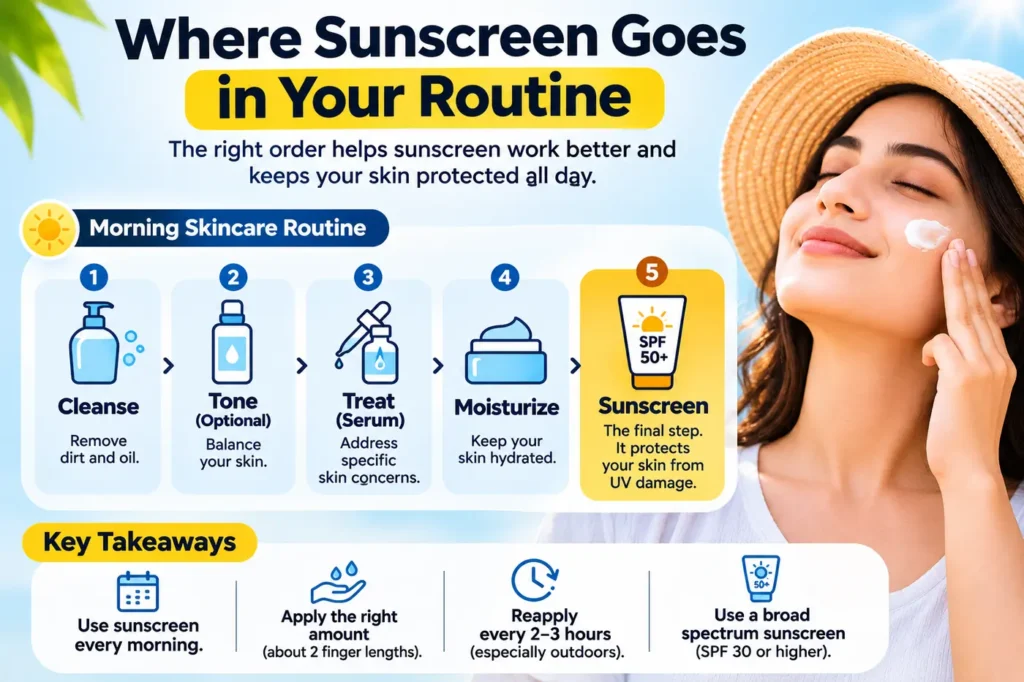
Sunscreen is always the last step of a morning routine — after moisturiser, before makeup. See our guide to the correct skincare routine order for the full sequence. Applying it under moisturiser dilutes it and can reduce the protection you actually how to choose sunscreen get.
Common Sunscreen Myths
- “Higher SPF means I can skip reapplying.” False — reapplication timing stays the same regardless of SPF number.
- “Dark skin doesn’t need sunscreen.” Darker skin tones have more natural UV protection but are not immune to UV damage, and are often diagnosed with skin cancer later, when it’s more advanced.
- “I don’t need it on cloudy days or indoors.” Up to 80% of UV rays pass through cloud cover, and UVA rays pass how to choose sunscreen through window glass.
Who Needs Extra Care
- Pregnancy: mineral sunscreens are generally preferred.
- Infants under 6 months: rely on shade and clothing rather than sunscreen; from 6 months, a broad-spectrum SPF 30+ mineral formula can be used on exposed skin.
- Retinol or exfoliating acid users: skin becomes more sun-sensitive, so broad-spectrum SPF 30-50 is how to choose sunscreen non-negotiable.
Sources & Further Reading
- American Academy of Dermatology: How to apply sunscreen
- American Academy of Dermatology: Sunscreen FAQs
- MD Anderson Cancer Center: 8 common SPF questions, answered
- Health Canada: Sunscreens and sun safety
Related Reading
- Skincare Routine: The Correct Order for Morning and Night
- The Perfect Skincare Routine for Your Skin Type
- Benefits of Vitamin C Serum
- Acne and Acne Scarring Treatment
Browse more in Skin Care.
Editorial note: This article is for general information only and is not medical advice. Please speak to a qualified healthcare professional about any personal health or skin concern. Learn how we research and review our content in our Editorial Policy.