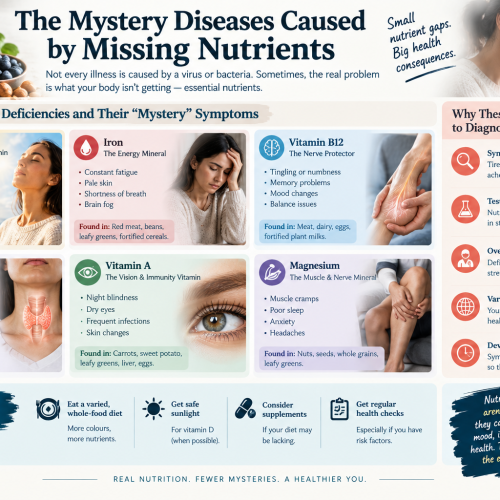
For most of medical history, some of the deadliest diseases in the world weren’t caused by germs, parasites, or bad luck — they were caused by what wasn’t on the plate. Scurvy, beriberi, and pellagra killed enormous numbers of people for centuries before anyone connected them to diet, and the way scientists eventually solved each mystery says as much about the danger of confirmation bias in medicine as it does about nutrition nutrient deficiency diseases itself.
Pellagra: The Disease Everyone Blamed on Germs

In the early 20th-century American South, pellagra killed thousands of poor sharecroppers, tenant farmers, and mill workers every year. It caused a grim cascade of symptoms — skin lesions, diarrhea, dementia, and often death — and the dominant medical theory of the time held that it was an infectious disease, since it clustered in institutions like orphanages and asylums.
In 1914, physician Joseph Goldberger was assigned to investigate pellagra. He noticed something the infection theory couldn’t explain.
In these institutions, inmates and patients developed pellagra, but the staff who cared for them almost never did. If the disease were contagious, staff members should have developed it too.
Goldberger therefore suspected diet. He focused on the “three Ms” — meat, meal, and molasses — which formed a large part of the rural poor’s diet but provided little fresh meat, milk, or vegetables.
He then tested his theory through dietary experiments. Adding fresh foods such as eggs, milk, peas, and oatmeal caused pellagra rates to fall dramatically.
Beriberi: Solved by Watching Chickens
Beriberi — a disease causing nerve damage, muscle weakness, and heart failure — was epidemic across parts of Asia in the 19th century, particularly wherever polished white rice had replaced whole-grain rice as the dietary staple. Dutch physician Christiaan Eijkman, working in Indonesia in the 1890s, made an accidental breakthrough when he noticed that laboratory chickens fed on polished white rice developed symptoms resembling beriberi, while chickens fed on unpolished, whole rice did not. It turned out the rice bran — removed during polishing — contained the nutrient now known as thiamine (vitamin B1). Removing the outer layer of the grain for a more refined, longer-lasting product had inadvertently stripped out the exact nutrient people nutrient deficiency diseases needed most.
Scurvy: The Disease That Took 200 Years to Solve Properly
Scurvy plagued sailors on long ocean voyages for centuries, killing more of them than combat, shipwreck, and storms combined during the Age of Sail. In 1747, naval surgeon James Lind ran one of the earliest known controlled clinical trials, giving groups of scurvy-afflicted sailors different treatments — cider, vinegar, seawater, citrus fruit, and other remedies then in circulation. The sailors given oranges and lemons recovered dramatically faster than every other group. Yet it took decades after Lind’s trial for the British Navy to adopt citrus rations widely, and it took until the 1930s for vitamin C itself to be isolated and definitively nutrient deficiency diseases identified as the missing nutrient.
The Pattern Behind All Three
What’s striking about pellagra, beriberi, and scurvy isn’t just that they were nutrient deficiencies — it’s how long each disease persisted after enough evidence existed to solve it, simply because the prevailing medical theory of the time (infection, spoiled food, bad air) pointed researchers in the wrong direction. In every case, the eventual solution came from someone willing to test a boring, unglamorous hypothesis — a plain diet change — against a more exciting, more socially convenient theory that the medical establishment already nutrient deficiency diseases believed.
Frequently Asked Questions
What causes pellagra?
Pellagra is caused by a dietary deficiency of niacin (vitamin B3), historically common among people whose diet consisted mainly of corn, with little access to fresh meat, milk, or vegetables.
Who discovered that pellagra was caused by diet, not infection?
Dr. Joseph Goldberger, a U.S. Public Health Service physician, demonstrated through a series of experiments between 1914 and 1916 that pellagra was a dietary deficiency disease, not a contagious nutrient deficiency diseases one.
What causes beriberi?
Beriberi is caused by a deficiency of thiamine (vitamin B1), historically linked to diets heavily reliant on polished white rice, which has had its thiamine-rich outer bran layer nutrient deficiency diseases removed.
How was the cause of beriberi discovered?
Physician Christiaan Eijkman noticed in the 1890s that laboratory chickens fed polished white rice developed beriberi-like symptoms, while those fed unpolished rice did not, pointing toward the rice bran as the missing protective factor.
What causes scurvy?
Scurvy is caused by a severe deficiency of vitamin C, historically common among sailors on long voyages without access nutrient deficiency diseases to fresh fruit or vegetables.
Who first proved citrus fruit could prevent scurvy?
Naval surgeon James Lind ran a controlled experiment in 1747 showing that sailors given oranges and lemons recovered from scurvy far faster than those given other remedies, though it took decades for this finding to be widely nutrient deficiency diseases adopted.
Why did it take so long to solve these deficiency diseases once evidence existed?
In each case, the prevailing medical theory of the era (infection or spoiled food) discouraged researchers from seriously investigating diet as the cause, delaying acceptance of the correct explanation by years or nutrient deficiency diseases decades.
Conclusion
Pellagra, beriberi, and scurvy are sometimes taught as simple vitamin-discovery trivia, but the real story is about how medical consensus can delay obvious answers. In every case, the fix was a specific, ordinary food — fresh vegetables, unpolished rice, citrus fruit — and the mystery wasn’t really about biochemistry. It was about which idea researchers were willing to take nutrient deficiency diseases seriously.
Sources & Further Reading
Primary sources: the NIH history archive on Joseph Goldberger and the James Lind Library account of Goldberger’s pellagra research.
Related reading: forgotten foods that protected ancient humans from deficiency and the vitamins people almost forgot about.