





Medically informed content: This article is based on peer-reviewed dermatology research and public-health guidance. It is for general education and is not a diagnosis or personalised treatment plan.
Chronic psychological stress may contribute to conditions that make skin age less well, but scientists have not proved that stress directly makes facial wrinkles form faster in humans.
For more on this, see our guides to stress management techniques that calm anxiety and how to build the perfect skincare routine for your skin type.
The evidence is strongest for stress-related changes in skin-barrier recovery, inflammation, oxidative balance and cellular repair. A recent exploratory study also found measurable differences in skin appearance and function between people reporting mild and moderate chronic stress. However, long-term human studies that track stress exposure and newly formed wrinkles are still limited.
The most accurate conclusion is that stress is a plausible contributing factor, not a proven primary cause comparable with cumulative ultraviolet exposure, smoking, genetics and chronological ageing. If stress is already causing dryness, redness or sensitivity, our stress-relief skincare guide explains which barrier-supporting ingredients may help.
The evidence-based answer
“Stress affects skin biology” is supported by research. “Every stressful month permanently adds wrinkles” is not.
What the Evidence Shows at a Glance
| Research question | Best current answer | Confidence |
|---|---|---|
| Does stress affect human skin function? | Yes. Human studies show effects on barrier recovery and other physiological measures. | Moderate |
| Can stress hormones alter skin cells? | Laboratory research reports changes in repair, oxidative stress and extracellular-matrix activity. | Moderate |
| Do stressed people show ageing-related skin changes? | Some exploratory and observational findings suggest an association. | Low–moderate |
| Is faster wrinkle formation proven? | No. Direct longitudinal human evidence remains insufficient. | Clear limitation |
Why the Answer Is Not a Simple Yes
Wrinkles develop through several overlapping processes. With age, skin becomes thinner, drier and less elastic, while deeper tissues lose collagen and fat. Ultraviolet radiation damages collagen and elastin, smoking and pollution contribute to extrinsic ageing, and repeated facial movement can make expression lines more persistent. Genetics also influences when and where wrinkles appear (Mayo Clinic).
Stress is harder to isolate. People experiencing chronic stress may also sleep poorly, smoke or drink more, eat differently, get less physical activity, or spend less time caring for their skin. Age, sun exposure, pollution and socioeconomic conditions can therefore blur the apparent relationship between stress and wrinkles.
A systematic review of skin-ageing risk factors mentioned stress as an exposure worth studying, but did not place it on the same evidentiary footing as better-characterised risk factors. The review noted that stress had mainly been discussed through mechanistic and perceived-age research rather than strong longitudinal wrinkle data (Scientific Reports).
What the Most Relevant Recent Study Found
A 2025 exploratory study compared people with mild versus moderate chronic psychological stress. The researchers also exposed human skin cells to the stress hormones cortisol and epinephrine in laboratory experiments.
The moderately stressed group showed lower skin antioxidant potential and changes in skin-barrier and appearance-related measures. In the cell experiments, higher stress-hormone exposure affected DNA integrity, extracellular-matrix synthesis, wound repair and proteins involved in barrier function. These findings support a biologically credible connection between chronic stress and processes relevant to skin ageing (Pujos and colleagues).
Why this study does not settle the wrinkle question
- It was exploratory, not a long-term trial tracking newly formed wrinkles.
- Participants were not randomly assigned to years of stress, so other lifestyle differences may have contributed.
- Cell experiments explain possible mechanisms but do not reproduce the full complexity of human life.
- The authors were affiliated with Coty Research and Development. That does not invalidate the results, but independent replication is important.
The careful interpretation is that chronic moderate stress was associated with measurable changes relevant to skin ageing. The study does not establish a predictable rate of extra wrinkle formation.

Five Ways Stress Could Influence Skin Ageing
1. Stress hormones alter skin regulation
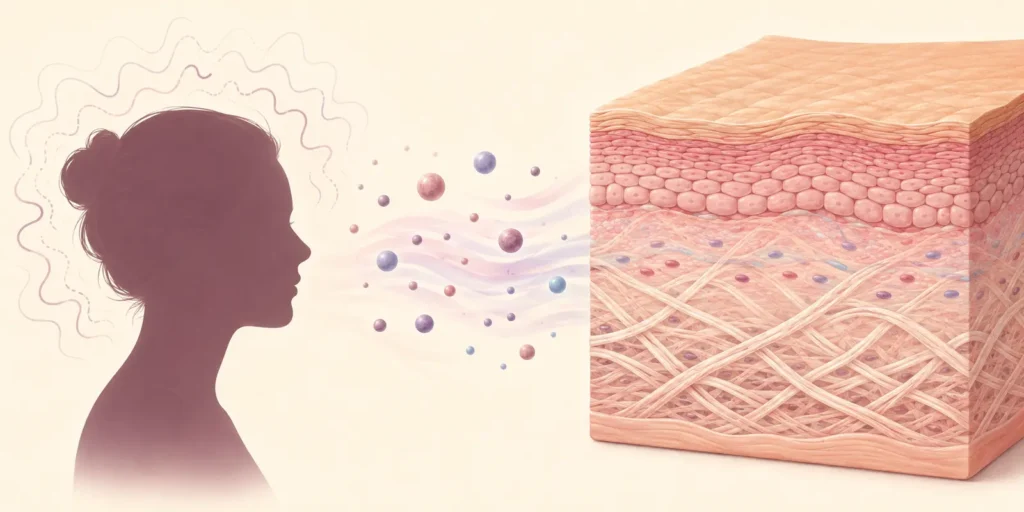
Psychological stress activates the hypothalamic-pituitary-adrenal axis and sympathetic nervous system. This raises mediators such as cortisol and adrenaline. A scientific review described plausible pathways involving immune dysfunction, reactive oxygen species and DNA damage, while also stating that conclusive evidence directly linking stress with skin ageing was lacking (Dunn and Koo).
2. Stress can impair barrier recovery
In a human experiment, psychological interview stress delayed recovery after the skin barrier had been disrupted and was accompanied by hormonal and inflammatory changes (Altemus and colleagues). Dryness can make existing fine lines look more obvious, but temporary dryness is not the same as a permanent structural wrinkle. Learn more about barrier hydration in our science-backed glass skin guide.
3. Inflammation and oxidative stress may affect repair
Persistent inflammatory and oxidative signalling may damage cellular components or interfere with normal repair. Laboratory findings make this pathway plausible, but they cannot tell us how much psychological stress matters compared with decades of UV exposure.
4. Stress changes sleep and behaviour
Stress may change sleep, diet, substance use and daily routines. These indirect routes can matter in everyday life. A stressed person who sleeps poorly, resumes smoking and stops using sun protection is exposed to several independent influences on skin appearance.
5. Facial tension may reinforce expression lines
Frowning and squinting create dynamic lines. As skin loses elasticity, some grooves remain visible at rest. Stress may increase brow furrowing or jaw tension in some people, but research has not quantified how much stress-specific movement changes long-term wrinkle depth.
Acute Stress Is Not the Same as Chronic Stress
A difficult week is unlikely to create permanent wrinkles suddenly. Acute stress is a short-term response. Chronic stress persists or repeatedly returns over weeks, months or longer.
Short-term stress may temporarily disturb sleep, hydration, facial tension or inflammation, making the face look tired, dull or more lined. Those changes may improve as sleep and normal routines return. Research concerns mainly involve persistent stress and repeated physiological activation, not one deadline or argument.
Can Reducing Stress Prevent Wrinkles?
No strong clinical trial has shown that meditation, breathing exercises, therapy or another stress-reduction programme prevents or reverses facial wrinkles. Stress management should not be marketed as an anti-wrinkle treatment.
Managing stress is still a sensible health decision. It may support sleep, reduce harmful coping behaviours and create better conditions for normal skin function. Helpful options include:
- regular physical activity appropriate for your health;
- a consistent sleep routine;
- short breathing, mindfulness or relaxation practices;
- talking with trusted people;
- professional support when stress feels persistent or unmanageable;
- avoiding smoking, vaping or excess alcohol as coping tools.
A varied diet can support general health, but no food erases wrinkles or “flushes cortisol.” For a realistic evidence-led approach, see our guide to 30 anti-inflammatory foods.
What Has Stronger Evidence for Preventing Premature Wrinkles?
Protect your skin from ultraviolet radiation
UV exposure is one of the clearest modifiable drivers of premature skin ageing. In a randomised trial, adults assigned to daily sunscreen use showed less progression of skin ageing over 4.5 years than those using sunscreen at their discretion (Hughes and colleagues).
Avoid smoking
Smoking is associated with premature skin ageing and wrinkling. Avoiding tobacco is a more evidence-based priority than buying an unproven supplement claiming to “lower cortisol.”
Support a dry skin barrier
A gentle moisturiser helps retain water and may reduce the visible prominence of fine dryness lines. It will not rebuild all lost collagen, but it can improve comfort and appearance.
Discuss proven treatments with a dermatologist
Topical tretinoin has clinical evidence for improving signs of photoageing, including fine wrinkles. A systematic review of seven randomised trials found consistent improvement, while noting differences between formulas and methods (Sitohang and colleagues). Retinoids can irritate skin and are not suitable for everyone, so seek professional advice, especially during pregnancy or when managing another skin condition.
When to Seek Professional Help
See a dermatologist if you are concerned about rapid or unusual skin changes, persistent irritation, a changing lesion, or treatment options for wrinkles. A dermatologist can distinguish normal ageing, sun damage, inflammatory skin disease and temporary dehydration.
Speak with a GP or mental-health professional if stress is affecting daily life, sleep, work or relationships, or if your own coping strategies are not helping. The NHS stress guide explains available support. Stress deserves care because it affects wellbeing, not because anyone should feel guilty about looking older.
Frequently Asked Questions
Can one stressful event cause permanent wrinkles?
There is no good evidence that one stressful event suddenly creates permanent wrinkles. Temporary dehydration, poor sleep and facial tension may make existing lines look more noticeable. Does cortisol destroy collagen?
Laboratory research suggests that glucocorticoid exposure can alter fibroblast activity, extracellular-matrix processes and tissue repair. Saying that everyday cortisol simply “destroys collagen” is an oversimplification. Are stress wrinkles a medical diagnosis?
No. “Stress wrinkles” is a popular description, not a standard medical diagnosis. Dermatologists assess wrinkles by location, depth, movement and contributing factors such as age, UV exposure, smoking and genetics.
Bottom Line
Chronic stress probably belongs on the long list of influences that can affect how skin functions and ages. Human and laboratory studies support several plausible pathways, but strong longitudinal evidence proving that stress independently makes facial wrinkles develop faster is still missing.
Manage stress for your health. For wrinkle prevention, prioritise sun protection, avoiding tobacco, gentle barrier care and evidence-based dermatological treatment when desired.
Research Sources
- Pujos M, et al. Impact of Chronic Moderate Psychological Stress on Skin Aging.
- Dunn JH, Koo J. Psychological Stress and Skin Aging.
- Altemus M, et al. Stress-Induced Changes in Skin Barrier Function.
- Wong QYA, et al. Defining Skin Aging and Its Risk Factors.
- Hughes MCB, et al. Sunscreen and Prevention of Skin Aging.
- Sitohang IBS, et al. Topical Tretinoin for Treating Photoaging.
Medical disclaimer: GlowCulture provides general educational information and does not replace advice from your GP, dermatologist or mental-health professional. Seek urgent local help if you or someone else is in immediate danger.